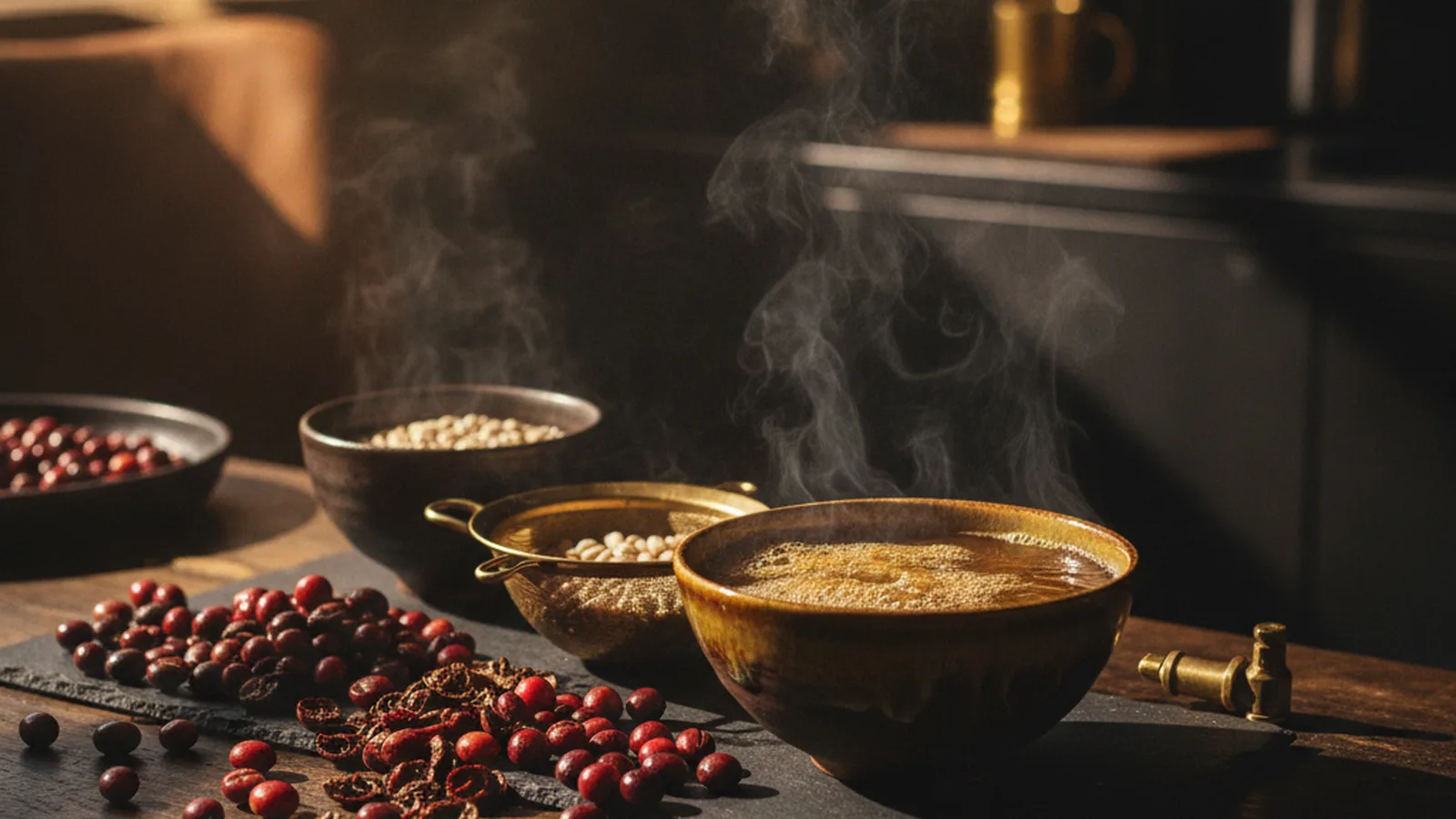
Image: Caffeine & Co studio
The Coffee Atlas
Yeast Fermentation in Coffee Processing
Yeast-inoculated coffee adds a chosen starter culture to cherries or mucilage to steer flavor. What peer-reviewed trials and two cupped lots actually show.
Flavor profile
avg. of 2 published reviewsScale: 1-10, Coffee Review / SCA-classic-form convention. Averaged from 2 independently published, dated Coffee Review lot scores of yeast-inoculated coffees: Kona Geisha Peaberry Yeast Fermentation Washed (Paradise Roasters, June 2024) and Ethiopia Ardi Yeast Natural (Coffee By Design, December 2024). Two lots cannot represent a whole technique: the yeast strains, substrates, and fermentation times differ between them, and the Ethiopian lot's yeast mixture is described only as proprietary. Treat these numbers as a snapshot of two well-made examples, not a category average.
What it tastes like
Yeast fermentation in coffee means adding a chosen starter culture, rather than leaving the cherries to whatever microbes happen to be present. In the lab version, Elhalis and colleagues inoculated wet fermentations with Hanseniaspora uvarum and Pichia kudriavzevii. The added yeasts dominated, used the sugars in the mucilage faster and more completely, and left 2-3 fold higher concentrations of metabolites such as alcohols, esters, and organic acids in the green beans than spontaneous fermentation did.
The cup result is modest. A three-person Q-Grader panel scored the combined-yeast coffee 82.0 against 80.3 for the spontaneous control, and the H. uvarum coffee actually scored lower than the control at 79.8; the authors report the sensory differences were not statistically significant (p > 0.05). The yeast matters: Bressani et al. found caramel-type roasted volatiles from Saccharomyces cerevisiae but fruity ones from Candida parapsilosis, so “yeast” is a family of tools, not one flavor.
On the specialty shelf the technique shows up in very different coffees. Paradise Roasters’ Kona Geisha Peaberry adds a yeast-inoculated step to a washed process and read wisteria, lemongrass, dried nectarine, and cocoa nib at 95 points. Coffee By Design’s Ethiopia Ardi ferments natural-process fruit for 96 hours with a proprietary yeast mixture and read Meyer lemon, spearmint, and sugarcane at 93.
Two lots are an illustration, not proof that yeast produces a particular flavor. A good starter culture narrows the range of what the ferment can do, but the variety, altitude, and the producer’s control of time and temperature still decide the cup.
How to brew it
Method fit for this origin · editorial guidance from roaster convention
A filtered, clean cup is the usual way roasters present yeast-inoculated lots, since the point of the technique is clarity of added fruit and floral aromatics.
Yeast lots can work as espresso, but the bright, high-toned acidity both reviewed lots show may read sharp under pressure without a dialed-in recipe.
Immersion gives the syrupy body reviewers noted, though paper filtration keeps the delicate aromatics more distinct.
⚠ Fit tiers are editorial guidance drawn from roaster convention; no industry standard scores brew fit, so we show tiers, never invented numbers. Editorial judgment based on the cup descriptions in the two Coffee Review lots above and general specialty-roaster practice, not on measured extraction data or an SCA-defined standard.
Caffeine content
Caffeine by dry weight · each gold dot = 0.1%
Caffeine content tracks species, not processing method: Robusta beans contain almost twice as much caffeine as Arabica (see Sources & data). Both reviewed yeast lots are Arabica. Some lab studies measure small changes in green-bean caffeine during fermentation, but no credible per-process caffeine figure exists for a brewed cup, so this page publishes none.
Where to buy it
Transparency: some links on this site are affiliate links; if you buy through them we may earn a commission at no cost to you. Roasters are picked for genuine, current sourcing of this coffee, never for who pays us.
Hilo, Hawaii roaster whose Kona Geisha Peaberry Yeast Fermentation Washed was scored 95 by Coffee Review; check the shop for current lots.
View lot→Portland, Maine roaster whose Ethiopia Ardi Yeast Natural was scored 93 by Coffee Review; availability varies by season.
View lot→Specialty coffee company associated with yeast-inoculated Colombian lots such as Finca La Praderita; check current listings for processing detail.
View lot→Selection is wide and uneven: check roast dates, look for listings that name the yeast or fermentation step, and read seller reviews.
View lot→Sources & data
- Elhalis et al.: Wet Coffee Fermentation Inoculated With Hanseniaspora uvarum and Pichia kudriavzevii (Frontiers in Microbiology, 2021)Peer-reviewed: inoculated yeasts dominated the ferment, used mucilage sugars faster and more completely, and produced 2-3 fold higher metabolite concentrations; three Q-Grader panel scored combined yeasts 82.0, P. kudriavzevii 81.5, H. uvarum 79.8, control 80.3
- Bressani et al.: Characteristics of fermented coffee inoculated with yeast starter cultures using different inoculation methods (LWT, 2018)Abstract record: three yeast strains applied to cherries in dry processing; caramel-type volatiles after roasting with Saccharomyces cerevisiae, fruity ones with Candida parapsilosis; higher citric and malic acid in inoculated lots
- Coffee Review: Kona Geisha Peaberry Yeast Fermentation Washed, Paradise RoastersFull attribute cupping scores and tasting notes (1 of 2 averaged); reviewed June 2024, washed process with a yeast-inoculated fermentation step
- Coffee Review: Ethiopia Ardi Yeast Natural, Coffee By DesignFull attribute cupping scores and tasting notes (2 of 2 averaged); reviewed December 2024, natural process with a proprietary yeast mixture fermented 96 hours
- Crozier et al.: Espresso coffees, caffeine and chlorogenic acid intake (Food & Function, 2012)Peer-reviewed (Univ. of Glasgow): states robusta coffee beans contain almost twice as much caffeine as arabica, by species; no per-percentage figures are cited here