Image: Caffeine & Co studio
The Coffee Atlas
Anaerobic Coffee Processing
Anaerobic coffee processing seals cherries in oxygen-free tanks to build fruit-forward cups: the real fermentation mechanism and its competition-circuit rise.
Flavor profile
avg. of 2 published reviewsScale: 1-10, Coffee Review / SCA-classic-form convention. Averaged from 2 independently published, dated Coffee Review lot scores of anaerobic-processed coffees: Ethiopia Gatta Anaerobic (Olympia Coffee) and Colombia Monteblanco Rodrigo Sanchez Carbonic Maceration (Klatch Coffee), both reviewed March 2023. Not a category-wide statistical sample: Coffee Review's own wider survey of 90 anaerobic-processed coffees scored a 79-95 range with an average of 89, so individual lots vary well outside what these two reviews alone can show.
What it tastes like
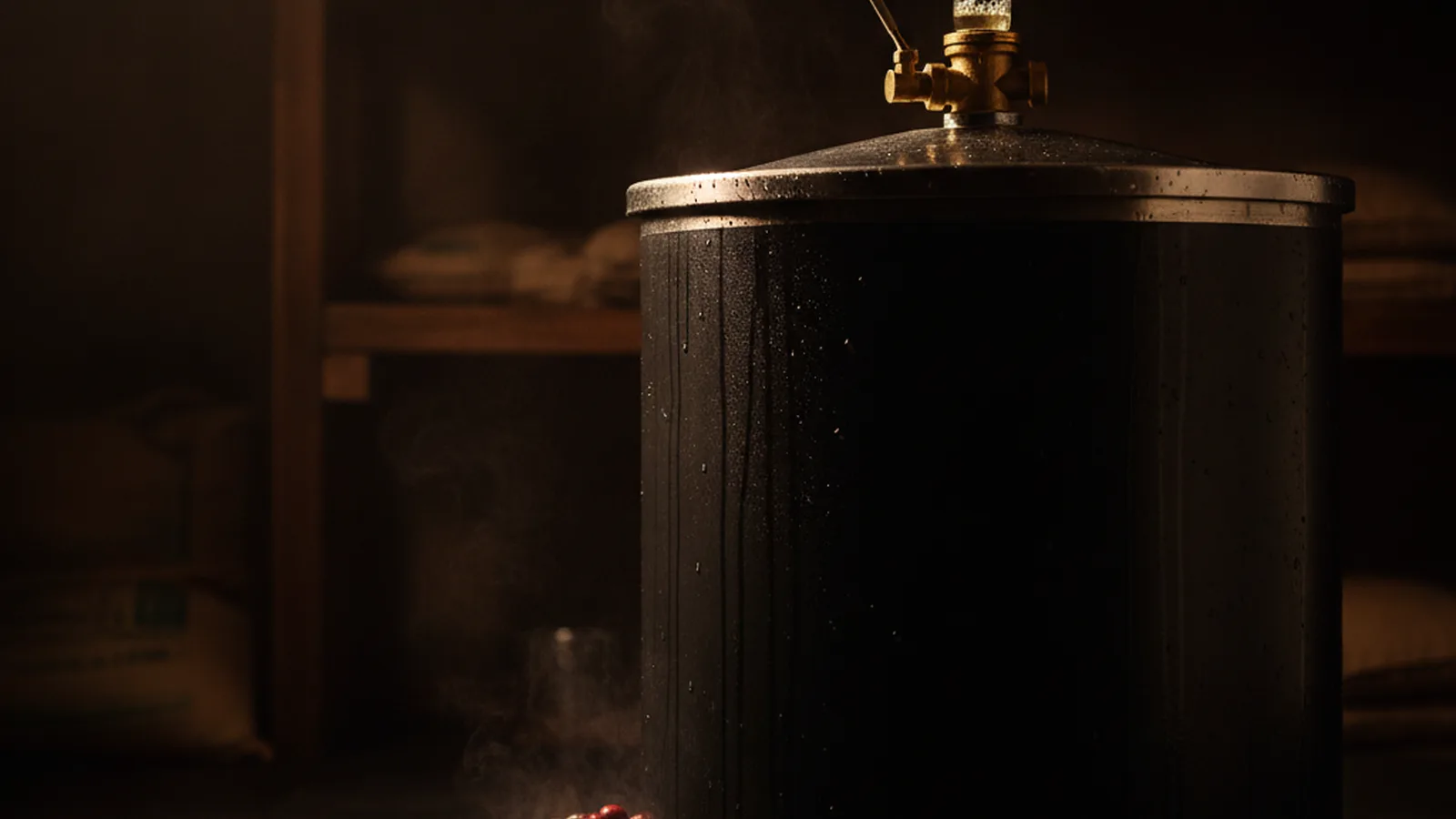
Anaerobic processing means fermenting coffee cherries or parchment inside a sealed, low-oxygen container instead of the open tanks or patios traditional washed and natural processing use. As 1Zpresso’s guide explains, producers load fruit into an airtight tank where oxygen gets displaced, either naturally by the CO2 fermentation itself produces, or by active injection, and that low-oxygen environment favors different microbes than open-air fermentation does. Cafe Imports describes the practical setup: stainless steel, thick plastic, or sealed GrainPro bags, often fitted with a one-way valve that lets built-up CO2 escape without letting outside air back in. Carbonic maceration, the specific variant Klatch Coffee used on its Coffee Review-scored Colombia Monteblanco lot, adds a second phase: after an initial whole-fruit ferment in a closed CO2-injected tank, the skins come off and the beans ferment again in their own skins and juice before washing.
The coffee world didn’t invent this: fermenting fruit under CO2 is standard practice in winemaking, and it reached specialty coffee’s biggest stage when Australian barista Sasa Sestic served a cappuccino built on a 50% natural process, 50% washed carbonic maceration Sudan Rume, grown at Finca Las Nubes in Colombia, to win the 2015 World Barista Championship in Seattle, as Sprudge reported at the time. That win is generally credited with pulling the technique out of small-scale experimentation and onto competition-circuit and specialty shelves, where anaerobic and carbonic maceration lots have stayed a fixture ever since.
The two Coffee Review lots behind this page’s flavor profile show what the low-oxygen environment does to the cup: Olympia Coffee’s Ethiopia Gatta Anaerobic reads clove, cocoa, tangerine zest, honey, and orchid, while Klatch’s Colombia Monteblanco Carbonic Maceration reads rose, strawberry, cocoa, pink lemonade, and yogurt, both scored 94 and both leaning toward the intense floral and fruit-forward register that made the anaerobic style a talking point in the first place. Coffee Review’s own wider survey of 90 anaerobic coffees, averaging 89 with a 79-95 range, is the honest caveat: this style raises the ceiling more than it raises the floor, and a badly managed ferment produces exactly the boozy, medicinal off-notes that a well-managed one turns into vivid fruit and spice.
Because the fermentation is happening around the bean, not inside it, anaerobic processing changes sugars, acids, and aromatic precursors, not the bean’s underlying chemistry, which is also why the intensified flavor needs a gentler hand at the brewer: over-extracting an already hyper-soluble bean is what tips this style from vivid into unpleasant.
How to brew it
Method fit for this origin · editorial guidance from roaster convention
Gentle, filtered brewing lets the intense floral and fruit-forward esters anaerobic fermentation produces come through clearly, without the extra agitation that risks pushing an already hyper-soluble bean into boozy or medicinal territory.
Increasingly common on the competition stage, but the same hyper-soluble character that makes anaerobic lots vivid also makes them easy to over-extract at espresso's higher pressure and temperature, so a coarser grind or shorter shot is usually needed.
Full immersion adds contact time and agitation on top of a bean already prone to over-extraction, which roaster brewing guides warn is exactly what tips anaerobic lots into boozy or medicinal off-notes.
⚠ Fit tiers are editorial guidance drawn from roaster convention; no industry standard scores brew fit, so we show tiers, never invented numbers. Reflects brew guidance commonly published by specialty roasters for anaerobic and carbonic-maceration lots (extraction-control framing, not method comparison, drawn from The Blind Coffee Roaster's brewing guide), not an SCA-defined standard.
Caffeine content
Caffeine by dry weight · each gold dot = 0.1%
Caffeine content tracks species, not processing method: roughly 1.2% for Arabica versus roughly 2.2% for Robusta, close to double (see Sources & data). Sealed-tank fermentation changes the sugars, acids, and volatile compounds around the bean, not the bean's own caffeine content, so no credible anaerobic-vs-other-processing caffeine difference exists at a category level; this page compares a processing method, not one species, so neither row above is marked as this coffee.
Where to buy it
Transparency: some links on this site are affiliate links; if you buy through them we may earn a commission at no cost to you. Roasters are picked for genuine, current sourcing of this coffee, never for who pays us.
Oliver's Custom Coffee line runs almost entirely on anaerobic natural and extended-fermentation lots, including the Coffee Review-scored Ethiopia Gatta Anaerobic.
View lot→Pearl Reserve collection is built around anaerobic natural and co-fermentation lots, such as the El Salvador Jasal Orange Geisha Anaerobic Natural.
View lot→Competition-circuit roaster whose current single-origin lineup includes co-fermentation and rare-varietal lots from origins such as Panama, Ethiopia, Colombia, and Peru.
View lot→Boulder, Colorado roaster that publishes exact processing detail, including anaerobic washed lots, on every single-origin listing.
View lot→A fast-growing category; check that listings name the fermentation time and vessel, the details this page explains.
View lot→Sources & data
- Crozier et al.: Espresso coffees, caffeine and chlorogenic acid intake (Food & Function, 2012)Peer-reviewed (Univ. of Glasgow): states robusta coffee beans contain almost twice as much caffeine as arabica, by species (no percentage figures given in this paper)
- Development of a fast and simple method to identify pure Arabica coffee and blended coffee by Infrared Spectroscopy (J. Food Sci. Technol., 2021, PMC8292507)Peer-reviewed, open-access: "Arabica beans usually presents 1.0 to 1.5% w.w-1 of caffeine and Robusta beans presents 2.0 to 2.5% w.w-1" (quoted verbatim, source's own wording), source for this entry's 1.2% Arabica / 2.2% Robusta figures, both within the stated ranges
- Coffee Review: Anaerobic-Processed CoffeesCategory overview: 90 anaerobic coffees cupped, average score 89, range 79-95; 10 formally reviewed, scores 93-95
- Coffee Review: Ethiopia Gatta Anaerobic, Olympia CoffeeFull attribute cupping scores and tasting notes (1 of 2 averaged); reviewed March 2023
- Coffee Review: Colombia Monteblanco Rodrigo Sanchez Carbonic Maceration, Klatch CoffeeFull attribute cupping scores and tasting notes (2 of 2 averaged); reviewed March 2023, also describes the two-phase closed-tank CO2-injected carbonic maceration method used on this lot
- Cafe Imports: Anaerobic FermentationTrader explanation of the sealed-container mechanism: CO2 buildup excluding oxygen, one-way valves, named producer example (La Chumeca, Tarrazu, Costa Rica)
- 1Zpresso: A Guide to Anaerobic CoffeePlain-language fermentation mechanism: sealed tanks, oxygen displaced by CO2 (natural or injected), lactic acid bacteria activity
- Sprudge: Sasa Sestic of Australia Wins the 2015 World Barista ChampionshipCompetition-circuit origin story: Sestic's winning beverage was a 50% natural process, 50% washed carbonic maceration Sudan Rume cappuccino, grown at Finca Las Nubes (Camilo Merizalde and Julian Holguin, Colombia), which introduced carbonic maceration to the World Barista Championship stage in April 2015
- The Blind Coffee Roaster: How to Brew Anaerobic Process CoffeeBrewing-guidance framing: anaerobic beans are hyper-soluble and prone to boozy/medicinal over-extraction if brewed with high heat or agitation