Image: Caffeine & Co studio
The Coffee Atlas
Carbonic Maceration Coffee Processing
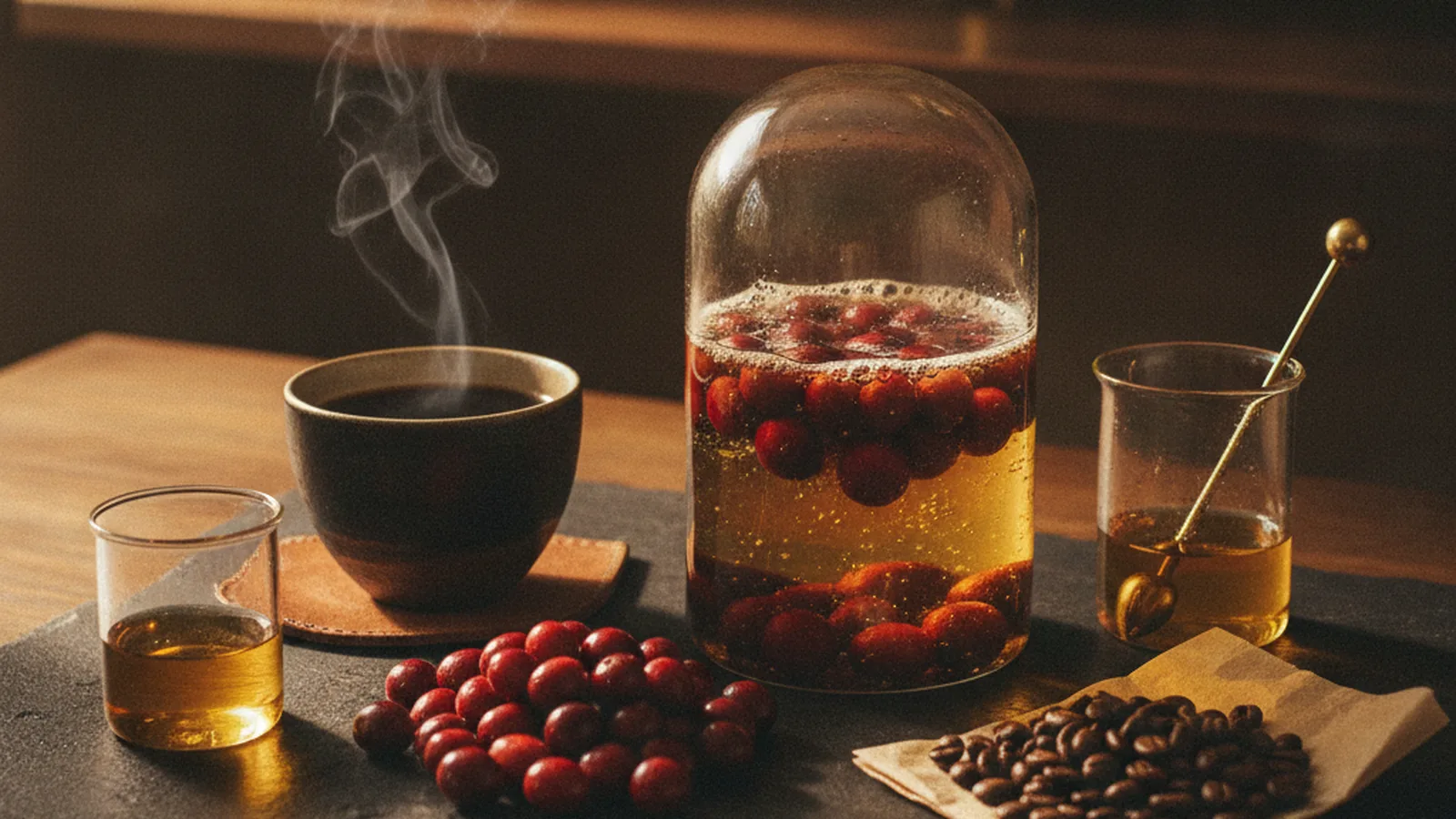
Carbonic maceration seals whole coffee cherries in CO2 to ferment inside out, the wine-borrowed technique that won the 2015 World Barista Championship.
Flavor profile
avg. of 2 published reviewsScale: 1-10, Coffee Review / SCA-classic-form convention. Averaged from 2 independently published, dated Coffee Review lot scores of carbonic-maceration-processed coffees: Rwanda Kungahara Carbonic Maceration (Red Rooster Coffee Roaster, reviewed April 2025) and Villa Loyola Carbonic Maceration (PT's Coffee Roasting Co., reviewed May 2021). Not a category-wide statistical sample: these are 2 named lots among many carbonic maceration coffees Coffee Review has cupped at a range of scores, so individual lots vary well outside what these two reviews alone can show.
What it tastes like
Carbonic maceration borrows its name and its mechanism from winemaking: Union Hand-Roasted’s explainer describes producers loading whole, unbroken coffee cherries, skins intact, into a sealed tank, then pumping it full of carbon dioxide. Because the fruit’s skin never breaks, fermentation starts inside each cherry rather than on its surface, a different chemistry than washed or standard anaerobic processing, where pulping exposes the sugary flesh to microbes from the outside in. Producers hold the tank at a controlled, deliberately low temperature to keep the ferment from tipping into heavy alcohol production, according to MTPak’s account of the coffee-industry technique.
Coffee only adopted the technique in 2015, when Australian barista Sasa Sestic built his winning World Barista Championship routine around it, adapting a fermentation method that wine writer Jancis Robinson has described as most associated with France’s Beaujolais region, as Sprudge reported at the time. Sestic’s beverage blended a 50% natural process, 50% washed carbonic maceration Sudan Rume, developed with Colombian farmer Camilo Merizalde, who grows Sudan Rume with fellow producer Julian Holguin at their farm, Finca Las Nubes, according to Sprudge. That win is generally credited with pulling carbonic maceration off the experimental fringe and onto specialty shelves, where it now sits as its own named processing category rather than a novelty, per Coffee Review’s own 2025 list.
The two Coffee Review lots behind this page’s flavor profile show what the sealed, whole-cherry ferment does to the cup: Red Rooster’s Rwanda Kungahara Carbonic Maceration reads Bing cherry, lemongrass, pomelo, agave syrup, and frankincense, scoring 95, while PT’s Villa Loyola Carbonic Maceration, grown in Pasto, Narino, Colombia, reads date, baking chocolate, lemon verbena, narcissus, and fresh-cut fir, scoring 93. Both lean toward high-toned fruit and floral intensity layered over real sweetness and body, the same register that made the process a competition talking point in the first place.
Because the whole cherry ferments rather than just the mucilage, carbonic maceration tends to push sweetness and fruit character further than a standard washed or even anaerobic-washed process, while staying cleaner than a fully natural-dried lot. That intensity is also why it rewards a gentler brew: over-extracting a bean this loaded with fermentation-driven sugars and acids is what turns a vivid cup into a boozy or medicinal one.
How to brew it
Method fit for this origin · editorial guidance from roaster convention
Clean filtration lets the vivid stone-fruit and floral top notes carbonic maceration produces come through without extra body muddying them.
The style's concentrated sweetness and acidity can make a striking shot, but roasters note it needs a lighter touch on dose or shot time than a washed lot of the same origin to avoid tipping sour.
Full immersion adds body a carbonic maceration lot already has plenty of, and roaster brewing guides warn it tends to blur the high-toned fruit character that is the point of the process.
⚠ Fit tiers are editorial guidance drawn from roaster convention; no industry standard scores brew fit, so we show tiers, never invented numbers. Reflects brew guidance commonly published by specialty roasters for carbonic maceration and other intensive-fermentation lots (extraction-control framing, not a method comparison), not an SCA-defined standard.
Caffeine content
Caffeine by dry weight · each gold dot = 0.1%
Caffeine content tracks species, not processing method: roughly 1.2% for Arabica versus roughly 2.2% for Robusta, close to double (see Sources & data). Sealed-tank, whole-cherry fermentation changes the sugars, acids, and volatile compounds around the bean, not the bean's own caffeine content, so no credible carbonic-maceration-vs-other-processing caffeine difference exists at a category level. This page compares a processing method, not one species, so no per-lot species claim is made here.
Where to buy it
Transparency: some links on this site are affiliate links; if you buy through them we may earn a commission at no cost to you. Roasters are picked for genuine, current sourcing of this coffee, never for who pays us.
US roaster (Jacksonville, Florida) whose Carbonic Maceration Guji program sources small-holder Hambela, Ethiopia lots and publishes full processing detail on each listing.
View lot→Coffee Review-cited for its Colombia Monteblanco Carbonic Maceration lot; regularly carries carbonic maceration and co-fermentation single origins in rotation.
View lot→Selection is thin and rotates fast for this specific process; check the listing itself names carbonic maceration (not just "anaerobic") before buying.
View lot→Sources & data
- Union Hand-Roasted Coffee: What Is Carbonic MacerationMechanism: whole sealed cherries, CO2 injection, intracellular fermentation happening inside the fruit rather than on its surface
- MTPak: Coffee trends, carbonic macerationMechanism: whole-cherry CO2 fermentation with low-temperature control to limit alcohol buildup; Sasa Sestic's 2015 collaboration with Colombian farmer Camilo Merizalde in adapting the wine technique to coffee
- Sprudge: Sasa Sestic of Australia Wins the 2015 World Barista Championship2015 WBC origin story: Sestic's winning beverage used a 50% natural process, 50% washed carbonic maceration Sudan Rume, first bringing carbonic maceration to the WBC stage; also quotes wine writer Jancis Robinson describing carbonic maceration as most associated with France's Beaujolais region, and confirms Camilo Merizalde and Julian Holguin (Colombia) grow Sudan Rume at their farm, Finca Las Nubes
- Coffee Review: Rwanda Kungahara Carbonic Maceration, Red Rooster Coffee RoasterFull attribute cupping scores and tasting notes (1 of 2 averaged); reviewed April 2025, scored 95
- Coffee Review: Villa Loyola Carbonic Maceration, PT's Coffee Roasting Co.Full attribute cupping scores and tasting notes (2 of 2 averaged); reviewed May 2021, scored 93, lot grown in Pasto, Narino, Colombia
- Coffee Review: The List, Coffee Review's Top 50 Coffees of 2025Confirms Red Rooster Coffee Roaster placed #2 among the year's most exciting roasters and that carbonic maceration is now an established, named processing category on Coffee Review's own list
- Crozier et al.: Espresso coffees, caffeine and chlorogenic acid intake (Food & Function, 2012)Peer-reviewed (Univ. of Glasgow): states robusta coffee beans contain almost twice as much caffeine as arabica, by species (no percentage figures given in this paper)
- Development of a fast and simple method to identify pure Arabica coffee and blended coffee by Infrared Spectroscopy (J. Food Sci. Technol., 2021, PMC8292507)Peer-reviewed, open-access: "Arabica beans usually presents 1.0 to 1.5% w.w-1 of caffeine and Robusta beans presents 2.0 to 2.5% w.w-1" (quoted verbatim, source's own wording), source for this entry's 1.2% Arabica / 2.2% Robusta figures, both within the stated ranges