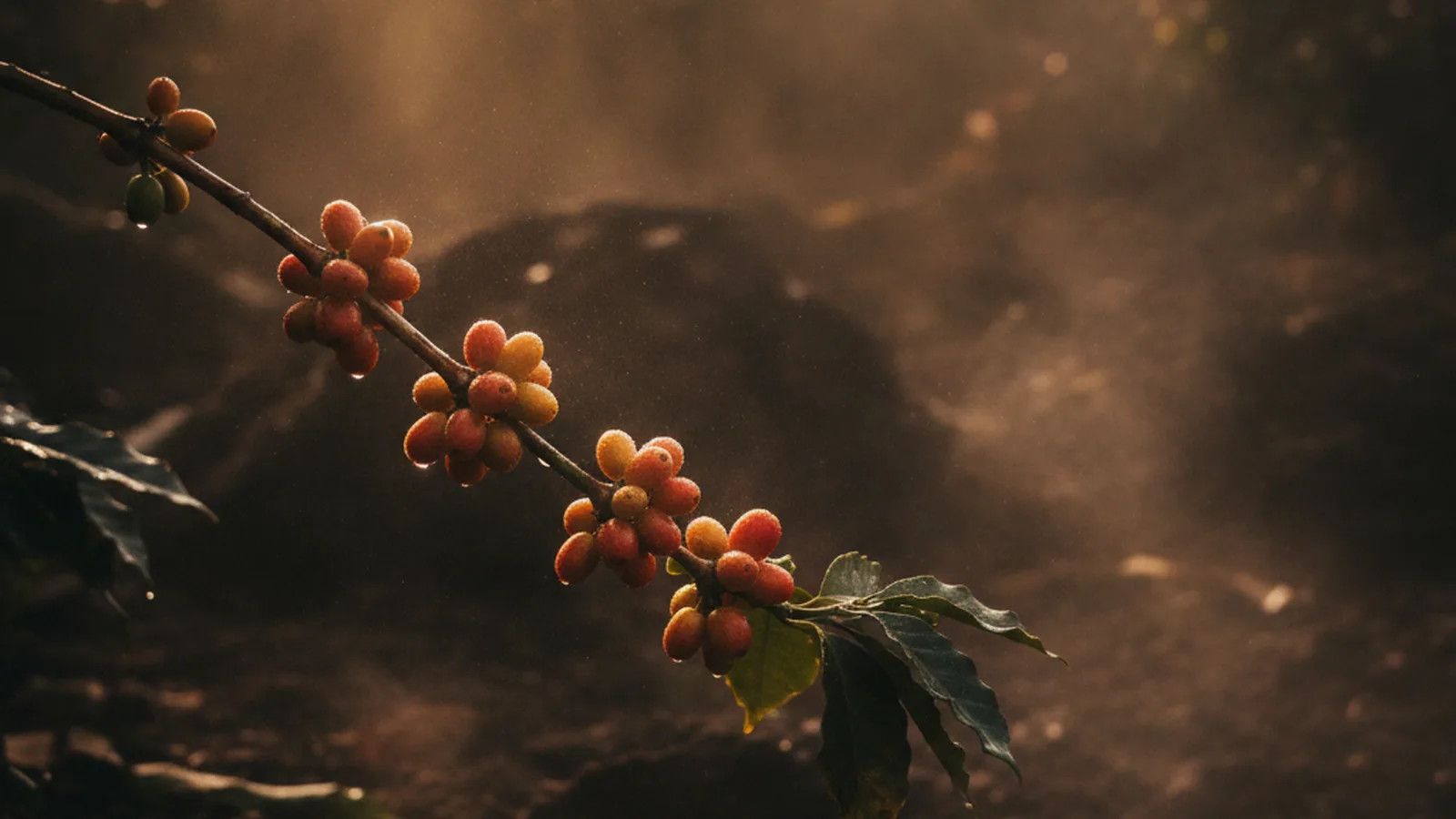
Image: Caffeine & Co studio
The Coffee Atlas
Panama Boquete Geisha
Panama's Boquete highlands on Volcan Baru grow the Geisha coffee behind record auctions, with sourced cupping scores, altitude data, and real citations.
Flavor profile
avg. of 2 published reviewsScale: 1-10, Coffee Review / SCA-classic-form convention. Averaged from 2 independently published, dated Coffee Review scores, both Geisha lots from Elida Estate (Alto Quiel, Boquete) but processed two different ways: a honey lot and an anaerobic natural lot. Not a category-wide statistical sample of Boquete Geisha as a whole: scores at other Boquete farms and lots range from the high 80s to the high 90s, and even Elida's own lots vary lot to lot and year to year.
What it tastes like
Boquete is a small highland district on the flank of Volcan Baru, Panama’s tallest peak, and its coffee farms climb the volcano’s slopes into some of the highest, coolest growing ground in Central America. Elida Estate, the Lamastus family’s farm in Alto Quiel, sits at 1,700 to 2,500 meters, the highest coffee farm in Panama, well above the roughly 1,000-2,000 meter range published for the wider Boquete district. That elevation, plus the volcano’s mineral-rich soil, is the physical reason a low-yielding, hard-to-grow Ethiopian variety found a second home here: slower cherry ripening at altitude concentrates the sugars and aromatics that make Geisha’s cup so distinct.
The two Coffee Review lots averaged for this entry are both Elida Estate Geisha, cupped a year apart and processed two different ways, yet they land within a point of each other. The 2020 honey lot, reviewed by Bona Kafo Roastery, scored 94 overall with lilac, myrrh, cocoa nib, pink peppercorn, and honey in the cup. The 2021 anaerobic natural lot, reviewed by Willoughby’s Coffee & Tea, scored 95 with lychee, pineapple, cocoa nib, lemon verbena, and ginger blossom. Different fermentation choices, same farm, same variety, and both land in the mid-90s: evidence the site itself, not just the processing, is doing real work.
Harvest in Boquete runs December through March, peaking in January and February, and the district’s coffee history runs deeper than Geisha alone: Catuai, Caturra, and Typica have grown on these same volcanic slopes for generations. What changed the district’s reputation was a single 2004 auction lot from Hacienda La Esmeralda, a few kilometers from Elida, that reset what buyers thought Panama coffee could be worth. The full price story behind that shift, and how far it has run since, is its own entry: see the Gesha varietal page for the auction timeline.
How to brew it
Method fit for this origin · editorial guidance from roaster convention
Filtered clarity is how Coffee Review's blind panel cupped both lots averaged above: it protects the lychee, pineapple, and ginger-blossom top notes that a heavier method would blur.
Doable for novelty, but concentrating this delicate, high-elevation cup under crema mutes the floral and stone-fruit aromatics that define it, so most roasters treat it as a side experiment, not the coffee's primary format.
Full immersion favors body over aromatic clarity, the opposite of what this altitude and this price point are grown for.
⚠ Fit tiers are editorial guidance drawn from roaster convention; no industry standard scores brew fit, so we show tiers, never invented numbers. Reflects brew guidance commonly published by specialty roasters for Boquete Geisha specifically, not an SCA-defined standard.
Altitude & region
Growing elevation, meters above sea level · this entry vs comparison bands
Elida Estate's range above is sourced directly to Boquete Coffee Traders' Lamastus Family Estates profile (see Sources & data), the specific Boquete farm behind this entry's two averaged Coffee Review scores. Kenya AA and Brazil Cerrado are shown for scale using commonly published origin altitude bands, not lot-specific measurements. Published altitude figures for the wider Boquete district vary noticeably by source, from roughly 1,000 m at the low end to 1,800-2,500 m at the high end; Elida Estate's own farm range is the number this entry's flavor data is actually grounded in.
Caffeine content
Caffeine by dry weight · each gold dot = 0.1%
Caffeine content tracks species, not origin, altitude, or processing: roughly 1.2% for Arabica versus roughly 2.2% for Robusta, close to double (see Sources & data). This entry is 100% Arabica Geisha; no credible per-origin or per-farm caffeine figure exists at a category level, so the comparison above is by species only, not a measurement of this specific lot.
Where to buy it
Transparency: some links on this site are affiliate links; if you buy through them we may earn a commission at no cost to you. Roasters are picked for genuine, current sourcing of this coffee, never for who pays us.
Dedicated Geisha collection spanning Panama, including Boquete farms, each independently Coffee Review scored 96 or above.
View lot→Competition-circuit roaster with rotating Panama Boquete Geisha lots alongside its standard menu.
View lot→Boquete Geisha appears at every price tier; cross-check farm names against this page before trusting a bargain.
View lot→Sources & data
- Coffee Review: Panama Boquete Torre Lot #1 Geisha Honey, Bona Kafo RoasteryCupping scores, September 2020, overall 94 (1 of 2 averaged)
- Coffee Review: Panama Elida Green-Tip Geisha La Torre ASD, Willoughby's Coffee & TeaCupping scores, April 2021, overall 95 (2 of 2 averaged)
- Coffee Review: scoring methodology1-10 attribute scale definition
- Boquete Coffee Traders: Elida Estate Coffee by Lamastus FamilyElida Estate altitude (1,700-2,500 m), Alto Quiel location, farm history, and highest-farm-in-Panama claim
- Boquete Coffee Traders: Panama Coffee Regions, Boquete, Volcan & RenacimientoDistrict-wide Boquete altitude range (roughly 1,000-2,000 m) and volcanic soil description, for comparison against Elida Estate's own sourced range
- Tourism Panama: 11 Coffee Farms in Boquete You Must VisitDistrict-wide Boquete altitude (1,000-2,100 m), named farm list including Elida Estate and Hacienda La Esmeralda
- Dulce Tropical: Panama Coffee Growing RegionsBoquete harvest window (December to March, peak January-February), regional altitude and variety breakdown
- Crozier et al.: Espresso coffees, caffeine and chlorogenic acid intake (Food & Function, 2012)Peer-reviewed (Univ. of Glasgow): states robusta coffee beans contain almost twice as much caffeine as arabica, by species (no percentage figures given in this paper)
- Development of a fast and simple method to identify pure Arabica coffee and blended coffee by Infrared Spectroscopy (J. Food Sci. Technol., 2021, PMC8292507)Peer-reviewed, open-access: "Arabica beans usually presents 1.0 to 1.5% w.w-1 of caffeine and Robusta beans presents 2.0 to 2.5% w.w-1" (quoted verbatim, source's own wording), source for this entry's 1.2% Arabica / 2.2% Robusta figures, both within the stated ranges