Image: Caffeine & Co studio
The Coffee Atlas
Kenya Double-Washed Process
Kenya's double-washed process ferments, rinses, then soaks coffee in clean water before drying: how it works and what two Coffee Review lots scored.
Flavor profile
avg. of 2 published reviewsScale: 1-10, Coffee Review / SCA-classic-form convention. Averaged from 2 independently published Coffee Review scores of washed Kenya AA lots: Kenya AA Kiru (Willoughby's Coffee & Tea, July 2009, 93 points, SL-28 and SL-34, fully washed and sun dried) and Nakuru Plumoir Single-Variety SL 34 AA Top (1980 Cafe, January 2026, 94 points, SL34, washed). Neither review documents the individual factory's fermentation or soaking steps, so this shows what well-made washed Kenyan lots taste like, not the isolated effect of the second soak. The two reviews are 17 years apart, small-N, and individual lots vary widely.
What it tastes like
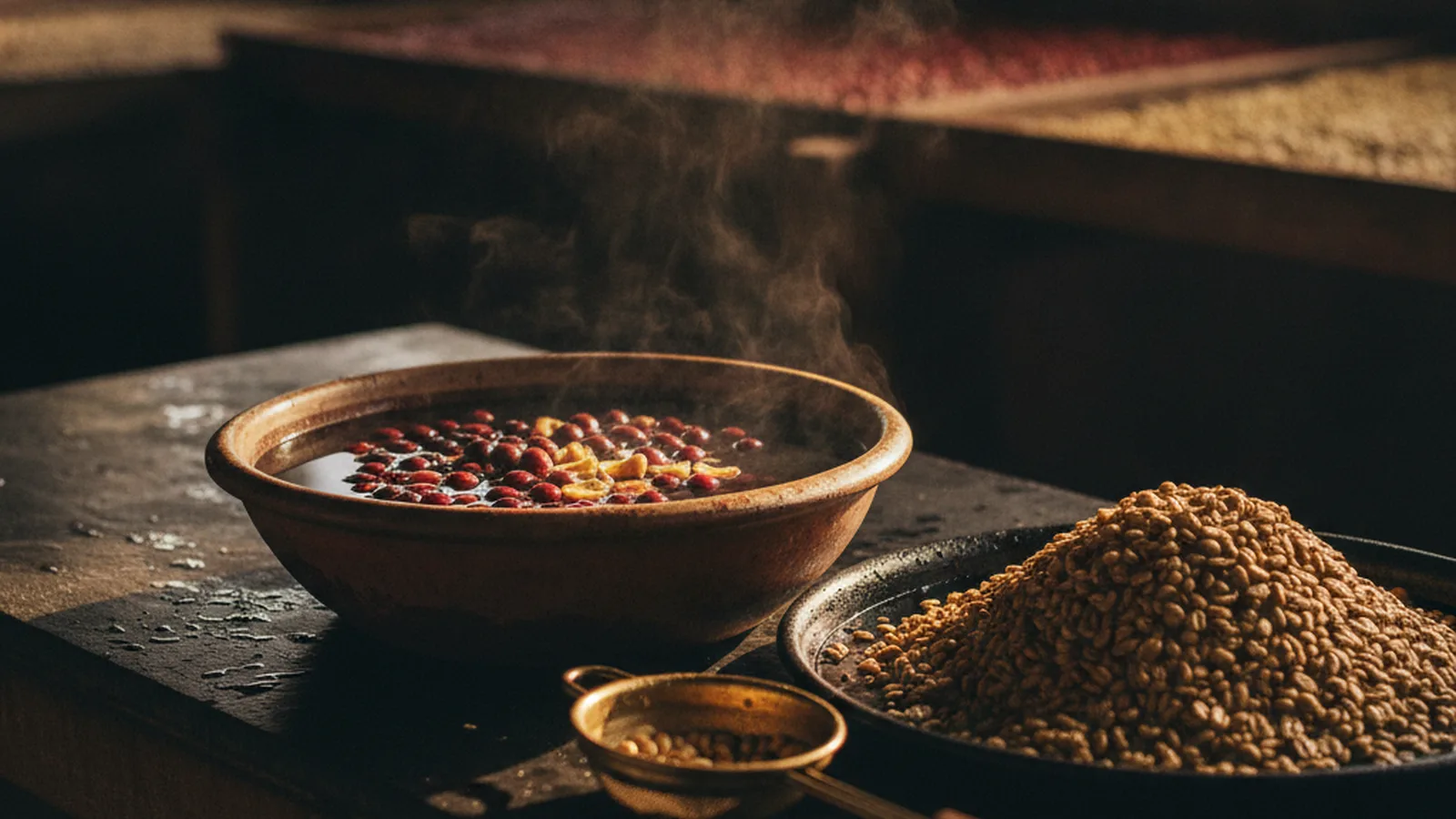
Kenya’s “double wash” is better described as a wash, a rest, and a second wash than as two separate fermentations. After pulping, the coffee is fermented, washed with clean water, then fermented again or left to soak, and washed a final time before drying, as 1zpresso’s Kenya guide lays out the sequence. The method is usually credited with sharper acidity and cleaner fruit.
The history is more practical than mystical. Barista Magazine reports it began as a way to hold washed coffee underwater, cool and protected from insects, until a drying bed came free. The same piece warns that the flavor effect is hard to pin down, since variety, temperature and water quality all move the result. No review here isolates the second soak, so treat the acidity claim as roaster lore with a plausible mechanism, not a measured result.
What the cup does show is consistent across two lots 17 years apart: black currant, grapefruit and floral notes with a cocoa undertone, high acidity, and a clean finish. Both Coffee Review lots score 93 or 94 and are washed SL28/SL34 coffees, so they describe what well-made Kenyan washed lots can taste like, not what every double-washed bag will.
How to brew it
Method fit for this origin · editorial guidance from roaster convention
Filtered clarity suits the bright, high-definition acidity and fruit this process is credited with delivering.
Works for fruit-forward shots, but the high acidity usually needs careful dialing in to avoid a sour cup.
Full immersion adds body but tends to soften the crisp acidity that drinkers seek in Kenyan coffee.
⚠ Fit tiers are editorial guidance drawn from roaster convention; no industry standard scores brew fit, so we show tiers, never invented numbers. Reflects brew guidance commonly published by specialty roasters for washed Kenyan lots, not an SCA-defined standard.
Altitude & region
Growing elevation, meters above sea level · this entry vs comparison bands
Kenya's band is sourced directly from 1zpresso's Kenya guide (see Sources & data) and is slightly wider than the 1,500-2,100 m band shown on this site's Kenya AA entry. Altitude is a feature of where the coffee grows, not of the double wash itself. Ethiopia Yirgacheffe and Brazil Cerrado are shown for scale only, using the typical bands already published on this site.
Caffeine content
Caffeine by dry weight · each gold dot = 0.1%
Caffeine content tracks species, not origin, altitude, or processing: roughly 1.2% for Arabica versus roughly 2.2% for Robusta, close to double (see Sources & data). Fermenting and soaking change a bean's acids and sugars, not its species-driven caffeine, and this entry covers Arabica lots only; no credible per-process caffeine figure exists.
Where to buy it
Transparency: some links on this site are affiliate links; if you buy through them we may earn a commission at no cost to you. Roasters are picked for genuine, current sourcing of this coffee, never for who pays us.
NYC micro-roaster that has sold washed Kenya AA lots, with detailed per-lot origin write-ups.
View lot→Boulder, Colorado roaster with a Kenya collection; its Kenya AA Small Lot Reserve scored 95 points from Coffee Review.
View lot→Long-running direct-relationship sourcing in Kenya's central highlands; rotates named washed lots.
View lot→Santa Cruz roaster with an established Kenya program, listed under its Africa collection.
View lot→Wide Kenya selection; check roast dates, 100%-origin labeling, and seller reviews before buying.
View lot→Sources & data
- Crozier et al.: Espresso coffees, caffeine and chlorogenic acid intake (Food & Function, 2012)Peer-reviewed (Univ. of Glasgow): states robusta coffee beans contain almost twice as much caffeine as arabica, by species
- Development of a fast and simple method to identify pure Arabica coffee and blended coffee by Infrared Spectroscopy (J. Food Sci. Technol., 2021, PMC8292507)Peer-reviewed, open-access: Arabica beans usually 1.0 to 1.5% caffeine, Robusta 2.0 to 2.5% (source's own ranges); basis for the 1.2% / 2.2% figures
- Barista Magazine: Understanding the Process, Double Fermentation (Tanya Nanetti, Feb 2023)Origin of the method as a way to hold washed coffee underwater until drying space was free, and the explicit caution that its flavor effect is hard to isolate and depends on variety, temperature and water quality
- 1zpresso: A guide to Kenyan coffeeKenya's 1,400-2,200 m typical elevation, Oct-Dec main harvest with a secondary crop, and the stage sequence: pulping, first fermentation, washing, second fermentation or soaking, final washing, drying
- Coffee Review: Kenya AA Kiru, Willoughby's Coffee & TeaCupping scores (1 of 2 averaged): July 2009, 93 points, SL-28 and SL-34, fully washed and sun dried
- Coffee Review: Nakuru Plumoir Single-Variety SL 34 AA Top, 1980 CafeCupping scores (2 of 2 averaged): January 2026, 94 points, SL34, washed
- Coffee Review: scoring methodology1-10 attribute scale definition