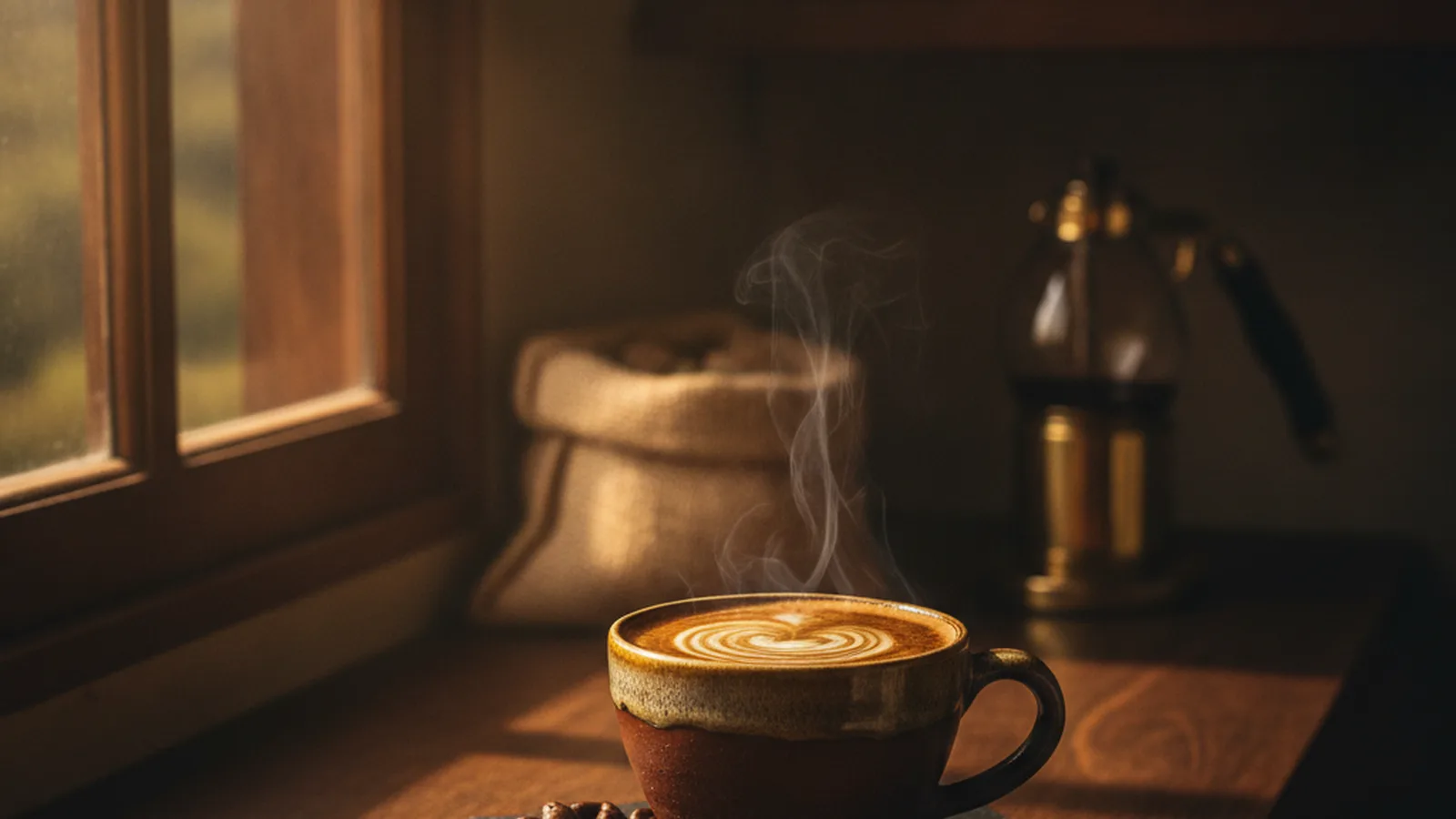
Image: Caffeine & Co studio
The Coffee Atlas
Bolivia Caranavi
Bolivia Caranavi coffee: a high-altitude Yungas origin with a sourced flavor profile and real altitude data, not just organic-and-Fairtrade adjectives.
Flavor profile
avg. of 2 published reviewsScale: 1-10, Coffee Review / SCA-classic-form convention. Averaged from 2 independently published, dated Coffee Review scores of washed Caturra-based lots from Caranavi Province, La Paz Department. Not a category-wide statistical sample: roast level and vintage differ between the two reviews (2013, 2016), and Caranavi also ships rarer natural-processed Geisha and peaberry microlots that score differently and are not represented in this average.
What it tastes like
Bolivia’s coffee industry is small enough that most of it, more than 90 percent by some estimates, comes from one province: Caranavi, a band of Yungas cloud forest a few hours northeast of La Paz where the Andes drop from the altiplano into Amazon-facing jungle. That geography is the whole story here. Farms sit high enough, routinely above 1,700 meters and pushing toward 2,000 on the best plots, that Caranavi competes on altitude with far better-known origins, while staying small enough (Bolivia exports under 1 percent of the world’s coffee) that almost nobody outside specialty circles has tasted it.
The two Coffee Review-scored lots behind this profile, both washed, Caturra-based, and grown in Caranavi Province, land on a similar cup: cocoa and dark chocolate up front, a nutty almond note, honeyed sweetness, and citrus or dried-apricot brightness carried by a delicate rather than sharp acidity. Both reviews also flag a resinous, fresh-cut-fir aromatic that does not map to any standard Flavor Wheel descriptor cleanly enough to tag, but that shows up often enough in Caranavi cupping notes to be worth calling out on its own: a cool, slightly piney top note layered over the chocolate and fruit.
What the cup does not show is Caranavi’s other export: a small volume of natural-processed Geisha and peaberry microlots that occasionally place at the top of regional cuppings, an entirely different, pricier product than the organic, Fair Trade, cooperative-grown washed lots most Caranavi coffee ships as. The washed lots profiled here are the ones a home roaster or cafe is actually likely to encounter.
Land reform in 1991 broke up Bolivia’s larger coffee estates into family-run farms of a few hectares each, and most Caranavi coffee still moves through cooperatives tied to that history, which is also why organic and Fair Trade certification show up on almost every bag: certification premiums matter more here than in origins with bigger buyer competition.
How to brew it
Method fit for this origin · editorial guidance from roaster convention
Filtered clarity lets the cocoa, dried-fruit, and citrus-zest notes both cited reviews describe show through without the delicate acidity getting lost.
The medium-to-full body carries well in full immersion, but the brisk-to-delicate acidity both reviews note comes across more muted than in a filtered cup.
Roasters commonly pull Caranavi lots as espresso for the chocolate and nut tones, but the reviewed lots' acidity needs careful dialling in to avoid a flat shot.
⚠ Fit tiers are editorial guidance drawn from roaster convention; no industry standard scores brew fit, so we show tiers, never invented numbers. Reflects brew guidance commonly published by specialty roasters for washed Bolivian lots, not an SCA-defined standard.
Altitude & region
Growing elevation, meters above sea level · this entry vs comparison bands
Bolivia Caranavi's 1,200-2,000 m range is sourced directly from Mercanta's Bolivia origin profile (see Sources & data). Colombia Huila, Kenya AA, and Brazil Cerrado are shown for scale using the same commonly published origin altitude bands already used elsewhere in this Atlas, not a Caranavi-specific measurement.
Caffeine content
Caffeine by dry weight · each gold dot = 0.1%
Caffeine content tracks species, not origin, altitude, or processing: published ranges put Arabica at roughly 1.0-1.5% and Robusta at roughly 2.0-2.5% by dry weight, close to double (see Sources & data). This entry is 100% Arabica; no credible per-origin caffeine figure exists at a category level, so growing at high Yungas altitude does not change this coffee's caffeine content.
Where to buy it
Transparency: some links on this site are affiliate links; if you buy through them we may earn a commission at no cost to you. Roasters are picked for genuine, current sourcing of this coffee, never for who pays us.
Denver roaster sourcing its Caranavi lot (Los Coloniales) directly from the women-led Union Pro-Agra cooperative.
View lot→Truckee, CA roaster with a current Fair Trade Organic Caranavi lot, Caturra and La Criolla varieties.
View lot→Direct-trade Caranavi Province lot from Organic and Smithsonian Bird Friendly-certified indigenous family farms.
View lot→Sources & data
- Coffee Review: Bolivia Caranavi, Cafe VirtuosoCupping scores (1 of 2 averaged); Caturra/Typica, washed, organic and Fair Trade certified
- Coffee Review: Bolivia Organic Uchumachi, The WestBeanCupping scores (2 of 2 averaged); 100% Caturra, processed at an organic-certified central station in Caranavi Province
- Coffee Review: scoring methodology1-10 per-attribute scale definition (aroma, acidity, body, flavor, aftertaste)
- Mercanta: Bolivia origin profileRegion list, specialty-grade altitude band (1,200-2,000 m), Jul-Nov harvest window, Arabica varieties (Typica, Caturra, Criollo, Catuai, Catimor), predominantly washed processing on raised African beds
- Podium Coffee Club: Bolivia coffee origin guideCorroborating altitude band for Caranavi's specialty farms and description of the region's varietal mix
- Development of a fast and simple method to identify pure Arabica coffee and blended coffee by Infrared Spectroscopy (J. Food Sci. Technol., 2021, PMC8292507)Peer-reviewed, open-access: states Arabica beans present 1.0-1.5% w/w caffeine and Robusta beans present 2.0-2.5% w/w, source for the caffeine-by-species figures above
- Kaladi Coffee Roasters: Bolivia Caranavi Los ColonialesCooperative name (Union Pro-Agra), lot-specific altitude (1,100-1,700 m), women-owned-farm sourcing detail