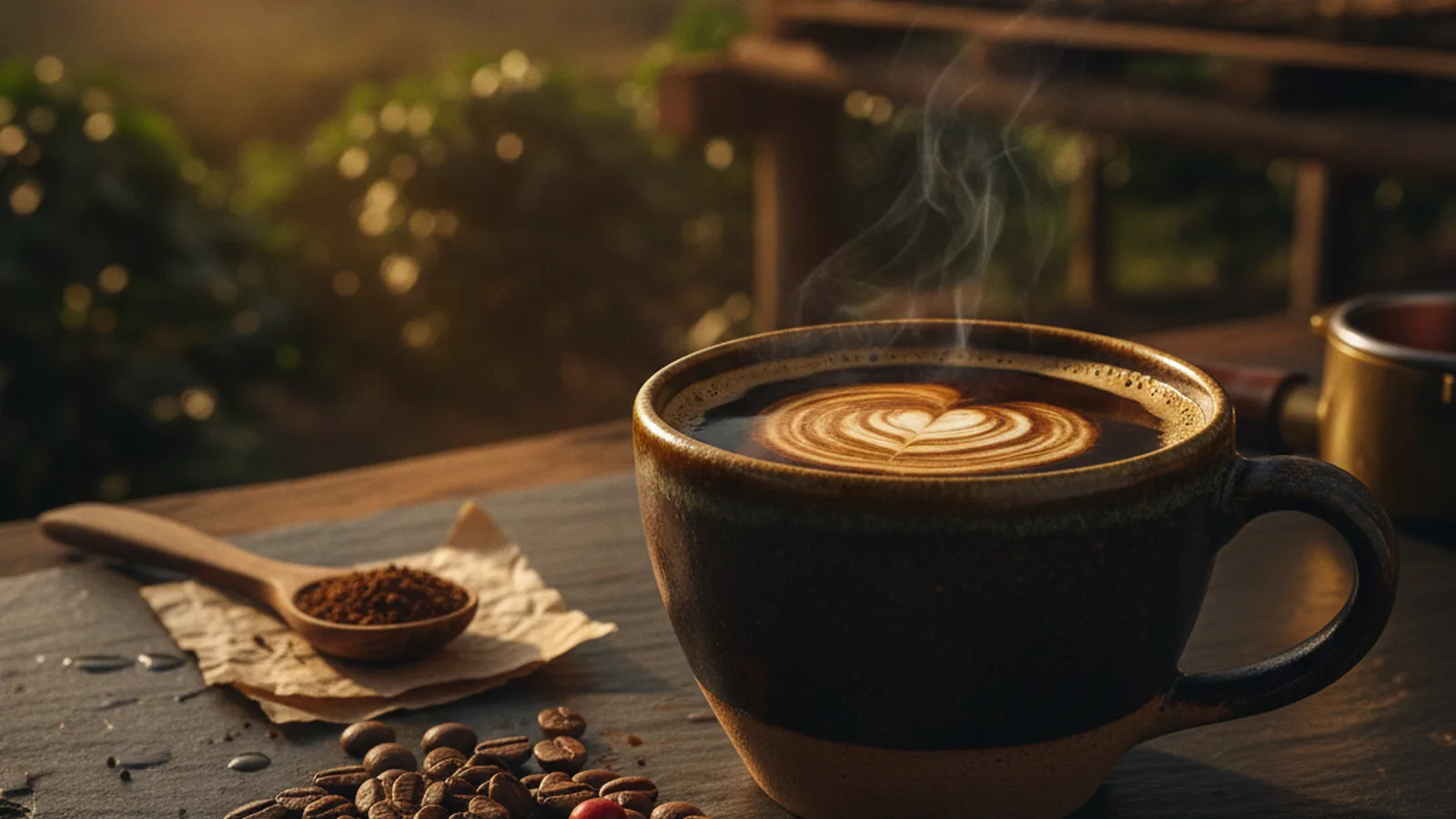
Image: Caffeine & Co studio
The Coffee Atlas
Peru Cajamarca
Peru's Cajamarca growers ship some of the world's most organic coffee, and this entry weighs the real certification cost against the real cooperative premium.
Flavor profile
avg. of 2 published reviewsScale: 1-10, Coffee Review / SCA-classic-form convention. Averaged from 2 independently published, dated Coffee Review scores of Cajamarca lots, both sourced from the Cenfrocafe cooperative, 3 years apart (Peru Cajamarca Fair Trade/Organic, Equator Coffees, March 2015, 92 points; Peru Cajamarca, Espresso Republic, April 2018, 89 points). Not a category-wide statistical sample: individual Cajamarca lots vary by washing station, harvest year, and grower.
What it tastes like
Cajamarca is Peru’s biggest coffee story by volume: Covoya Coffee puts roughly 43% of the country’s total production in this one northern department, grown almost entirely by smallholders on mixed plots of Typica, Bourbon, Caturra, Catimor, and Catuai between about 1,500 and 1,900 meters. Almost none of that coffee reaches export as an individually certified lot. Both cited Coffee Review scores behind this entry’s flavor profile, an Equator Coffees lot and an Espresso Republic lot, trace back to the same Cenfrocafe cooperative in Jaen and San Ignacio, and that is not a coincidence: it is close to the only route an organic Cajamarca lot has to market.
The reason is cost, not taste. Coffee & Conservation’s certification-cost breakdown puts a single organic inspection at $150 to $300 a day plus travel, running a 20-hectare independent farm in its case study over $3,000 a year once documentation and annual audits are added in, a scale larger than the smaller plots many individual Cajamarca smallholders farm, against a crop that a smallholder measures in a few thousand dollars of total income. A cooperative changes that math by spreading one audit and one set of records across thousands of members, closer to the $1,300-1,550 per producer organization that comparable co-op certification models report, and by carrying the three-year organic transition period, during which a farm gets none of the organic premium, as a collective cost rather than an individual one. Intelligence.coffee reports that in 2019 that premium was real: a Fairtrade minimum of $1.40 a pound, $1.70 for organic, plus a further 20-cent Fairtrade premium, against a C-market price that year of under $1 a pound, though the same reporting notes only 15 to 25% of Peru’s roughly 110,000 coffee growers actually belong to a Fairtrade-certified cooperative.
In the cup, both cited lots read as gentle rather than showy: candied walnut, honeysuckle, and ripe peach in the Espresso Republic lot, red currant, bakers’ chocolate, and lily-like florals in the Equator lot, with a light, very silky body and acidity both reviewers describe as soft rather than sharp. That combination, and the washed, sun-patio-dried processing Royal Coffee documents on its own Cajamarca lots, is why roasters consistently pitch this origin as an easy, everyday drip coffee rather than a single-cup showcase: nothing about the profile fights a milk drink or a big batch brew, and nothing about it demands the attention a brighter, higher-altitude cup would.
That combination of real cost and modest, unshowy flavor is also why Cajamarca rarely gets the marketing a Yirgacheffe or a Huila does, even while it quietly accounts for nearly half of Peru’s total coffee production. The premium a Cenfrocafe farmer earns for organic, Fairtrade certification is genuine money on top of a genuinely low commodity floor, but it is a certification the farmer could not access alone.
How to brew it
Method fit for this origin · editorial guidance from roaster convention
Both cited reviews describe a light, very silky mouthfeel and gentle acidity, exactly what filtered brewing is built to preserve rather than muddy.
Roasters and reviewers alike describe this profile as a classic, approachable everyday cup, the kind Cajamarca lots are commonly sold for rather than as a single-cup showcase coffee.
Doable, but the delicate, low-acid character here does less to cut through milk or crema than a brighter, higher-altitude origin.
⚠ Fit tiers are editorial guidance drawn from roaster convention; no industry standard scores brew fit, so we show tiers, never invented numbers. Reflects brew guidance commonly published by specialty roasters for gentle, low-acid washed South American lots, not an SCA-defined standard.
Altitude & region
Growing elevation, meters above sea level · this entry vs comparison bands
Peru Cajamarca's range is sourced directly from Covoya Coffee's organic Cajamarca lot profile, corroborated by Royal Coffee and the Smithsonian National Zoo (see Sources & data). Perfect Daily Grind's regional guide reports a wider 900-1,950 m band for Jaen and San Ignacio provinces as a whole; that broader provincial figure and this entry's narrower, organic/premium-lot-sourced range both sit inside the same reality, not in conflict. Colombia Huila, Kenya AA, and Brazil Cerrado are shown for scale using the same commonly published or registered origin altitude bands already cited elsewhere on this site, not a lot-specific measurement.
Caffeine content
Caffeine by dry weight · each gold dot = 0.1%
Caffeine content tracks species, not origin, altitude, or processing: roughly 1.2% for Arabica versus roughly 2.2% for Robusta, close to double (see Sources & data). This entry is 100% Arabica; no credible per-origin caffeine figure exists at a category level, so the comparison above is by species only, not a measurement of this specific lot.
Where to buy it
Transparency: some links on this site are affiliate links; if you buy through them we may earn a commission at no cost to you. Roasters are picked for genuine, current sourcing of this coffee, never for who pays us.
Wisconsin roaster that has sourced and been publicly reviewed for a Cajamarca Peru lot, noted for its sweet, easy-drinking, low-intensity profile; check current shop listings for availability.
View lot→Madison, Wisconsin roaster running a USDA Organic and Fair Trade Cajamarca lot (Peru Churupampa, Finca Churupampa in Chirinos); the roaster's own listing describes it as bright and fruity, with lime, grape, and brown sugar notes.
View lot→Selection is wide and quality varies lot to lot; check roast dates, 100%-origin labeling, and seller reviews before buying.
View lot→Sources & data
- Coffee Review: Peru Cajamarca Fair Trade/Organic, Equator CoffeesCupping scores (1 of 2 averaged); identifies the Cenfrocafe cooperative (over 2,000 farmers) as source
- Coffee Review: Peru Cajamarca, Espresso RepublicCupping scores (2 of 2 averaged); identifies the Cenfrocafe Cooperative as source
- Coffee Review: scoring methodology1-10 attribute scale definition
- Covoya Coffee: Peru Organic Top Cajamarca lot profileAltitude (1,500-1,900 m), variety (Bourbon, Catimor, Catuai, Caturra), washed processing, and the ~43%-of-total-production figure for Cajamarca
- Perfect Daily Grind: A Guide to Peru's Coffee-Producing Regional ProfilesIndependently corroborates Typica, Caturra, and Bourbon as varieties grown in Jaen and San Ignacio; separately states these two provinces sit at a wider 900-1,950 m band than this entry's headline altitude range (see altitude provenance note)
- Royal Coffee: Peru Organic Cajamarca El Chaupe lot profileSan Ignacio, Cajamarca altitude (1,400-1,750 m), May-Oct harvest window, wet-mill processing detail, Perales Huancaruna (PERHUSA) producer
- Smithsonian National Zoo: CAC La Prosperidad de Chirinos certified farm profileSan Ignacio district, Cajamarca altitude corroboration (1,200-1,900 m); organic, Fairtrade, and Rainforest Alliance certification
- Intelligence.coffee: Peru has pinned its hopes on Fairtrade coffee, will it be rewarded?Peru grower count (approx. 110,000), Fairtrade-cooperative share (15-25%), and 2019 Fairtrade minimum/premium pricing versus that year's C price
- Coffee & Conservation: How much does eco-certification cost?Organic inspection day-rate and per-farm cost figures, cooperative-versus-individual cost comparison, and the 3-year organic transition period
- Crozier et al.: Espresso coffees, caffeine and chlorogenic acid intake (Food & Function, 2012)Peer-reviewed (Univ. of Glasgow): states robusta coffee beans contain almost twice as much caffeine as arabica, by species (no percentage figures given in this paper)
- Development of a fast and simple method to identify pure Arabica coffee and blended coffee by Infrared Spectroscopy (J. Food Sci. Technol., 2021, PMC8292507)Peer-reviewed, open-access: Arabica beans usually present 1.0 to 1.5% w/w of caffeine and Robusta beans present 2.0 to 2.5% w/w, source for this entry's 1.2% Arabica / 2.2% Robusta figures, both within the stated ranges