Image: Caffeine & Co studio
The Coffee Atlas
Wet Hulling (Giling Basah)
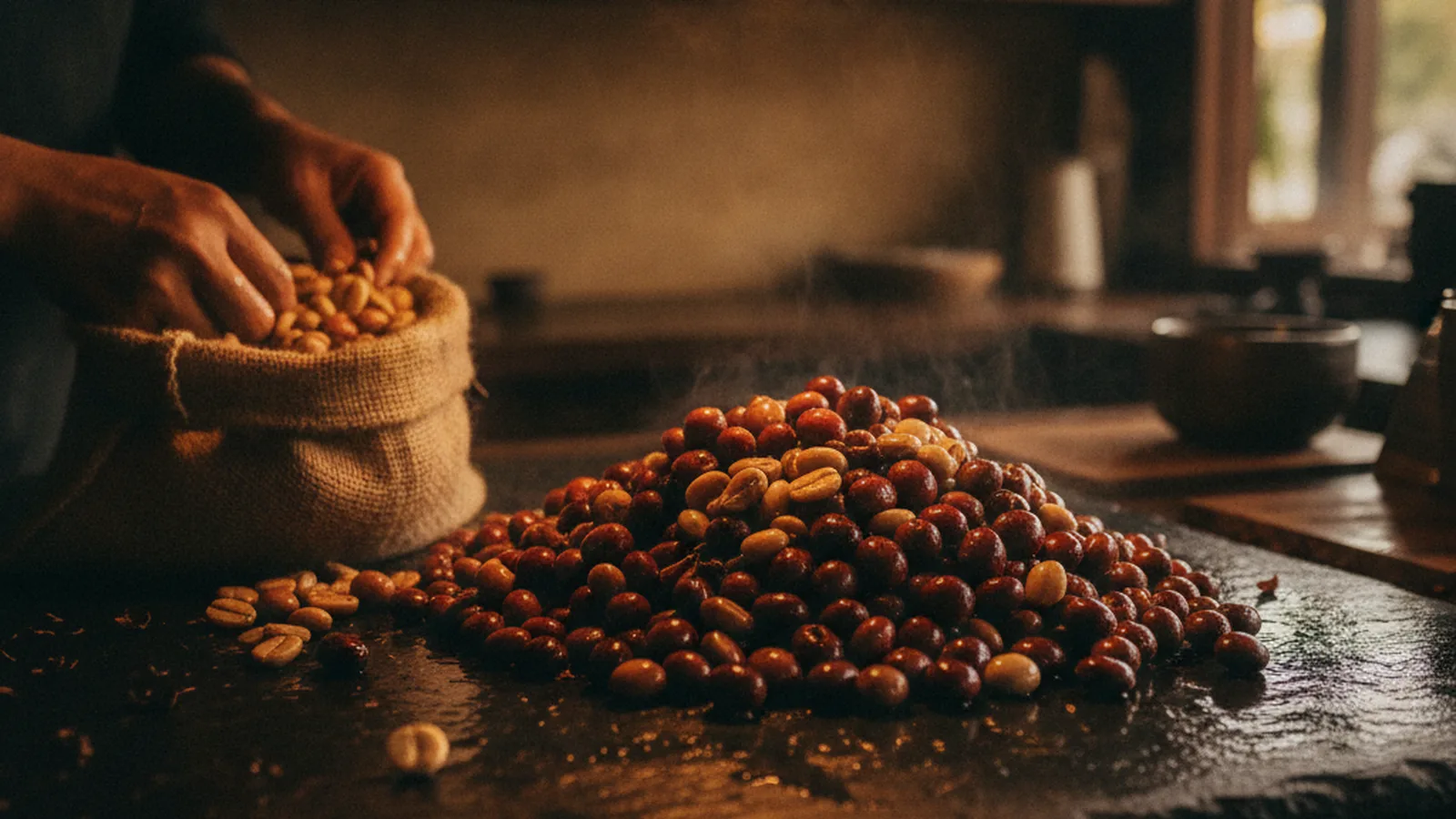
Wet hulling, giling basah, strips parchment early, giving Sumatra and Toraja coffee heavy body, low acidity, an earthy cup, with a sourced profile.
Flavor profile
avg. of 4 published reviewsScale: 1-10, Coffee Review / SCA-classic-form convention. Averaged from 4 independently published, dated Coffee Review scores of named wet-hulled lots: two Sumatra Mandheling lots and two Sulawesi Toraja lots, the two origins that anchor Indonesia's giling basah trade. Not a single-coffee measurement: giling basah is applied across many smallholder mills and origins, and Coffee Review's own wider Sumatra and Sulawesi catalog ranges from the low 80s to the low 90s, so individual lots vary by mill, harvest, and roast.
What it tastes like
Wet hulling, known in Indonesia as giling basah (“wet grinding”), is the step that separates Sumatra, Sulawesi, and Flores coffee from almost everywhere else arabica grows. Standard washed processing dries parchment coffee to around 11-12% moisture before hulling it for export; giling basah strips the parchment off while the bean is still far wetter. Cafe Imports puts the moisture at delivery to the mill at roughly 35-50%, well above that threshold, so the exposed green bean finishes drying naked rather than inside its protective parchment shell.
That reversal exists because of climate and cash flow, not flavor design. Sumatra’s Gayo and Lintong highlands see heavy rain and cloud cover through harvest, which makes the multi-week sun-drying washed processing needs unreliable at smallholder scale; hulling early cuts the coffee’s mass and lets it finish drying faster, with less mold risk. It also gets a farmer paid sooner: PT’s Coffee’s explainer describes smallholders selling their still-wet coffee to a local mill for quick payment rather than waiting out the two to three months washed processing typically takes. Some sources, including Acquired Coffee, trace the specific practice to 1970s Sumatra; the underlying economics of getting paid fast in a wet climate are the more consistently documented driver than any single origin date.
The process shows up directly in the cup. Pulling the parchment early and finishing the dry-down on exposed bean mutes acidity and thickens body, producing the earthy, tobacco-and-cedar, heavy-bodied profile that defines Sumatra Mandheling and Sulawesi Toraja alike, a sharp contrast to the bright, floral clarity washed processing produces (see Ethiopia Yirgacheffe for that other end of the spectrum). It is not a quality ceiling, though: the four named, dated Coffee Review lots behind this profile, two Sumatra Mandheling, two Sulawesi Toraja, cluster between 8 and 8.25 across every attribute and score 90 to 92 points overall, comfortably inside specialty range.
Wet-hulling is not limited to one island. Sumatra’s Gayo highlands in Aceh and the Lintong and Mandailing districts further south produce the bulk of the world’s wet-hulled coffee, Sulawesi’s Toraja highlands are the next best-documented source, and smaller volumes come out of Flores and Papua. Because the method is a mill-level choice rather than a varietal or terroir marker, quality swings lot to lot depending on how carefully a specific mill manages fermentation and the second drying pass, which is why the same “wet-hulled” label can describe both a refined, award-tier lot and a flat, musty one.
How to brew it
Method fit for this origin · editorial guidance from roaster convention
Low acidity and heavy, syrupy body hold up well under pressure brewing, one reason wet-hulled Indonesian lots show up so often as an espresso-blend base for body and crema.
Full immersion matches the heavy body wet-hulling produces without needing to showcase acidity this process was never built around.
Filtered clarity is built to showcase bright acidity, which wet-hulled coffee is specifically processed to mute; roasters generally steer these lots toward full-immersion brewing instead.
⚠ Fit tiers are editorial guidance drawn from roaster convention; no industry standard scores brew fit, so we show tiers, never invented numbers. Reflects brew guidance commonly published by specialty roasters for wet-hulled Indonesian lots, not an SCA-defined standard.
Caffeine content
Caffeine by dry weight · each gold dot = 0.1%
Caffeine content tracks species, not processing method: wet-hulling changes how parchment is removed and dried, not the bean's underlying chemistry. Roughly 1.2% for Arabica versus roughly 2.2% for Robusta, close to double (see Sources & data). Giling Basah is applied to both Arabica and Robusta lots in Indonesia, so caffeine content depends on which species a given wet-hulled lot is, not on the process itself.
Where to buy it
Transparency: some links on this site are affiliate links; if you buy through them we may earn a commission at no cost to you. Roasters are picked for genuine, current sourcing of this coffee, never for who pays us.
Specialty importer and roaster with a long-running, dedicated Sumatra program; its standard Mandheling lot is wet-hulled in the traditional giling basah style.
View lot→Runs an Indo-Pacific collection covering multiple wet-hulled Sumatra Mandheling roast levels, from medium to dark.
View lot→Dedicated Indonesian-coffee specialist; roasts a wet-hulled Sulawesi Toraja lot to order across multiple roast levels.
View lot→Sources & data
- Wikipedia: Giling BasahDefinition, mechanism (parchment removed at 30-35% moisture versus roughly 12% for standard washed processing), regions (Sumatra, Sulawesi, Flores, Papua), and flavor effect (reduced acidity, increased body)
- Cafe Imports: Wet-Hulled ProcessMechanism detail: coffee typically arrives at the mill at 35-50% moisture for hulling, versus 10-12% for most washed coffee; why the method gives smallholders more flexibility in remote, humid regions
- PT's Coffee: What is wet-hulled coffee?Step-by-step process with staged moisture targets (partial dry to ~50%, mill dries to 25-35% before hulling, final dry to 12-13%) and the cash-flow rationale: faster sale to a middleman versus 2-3 months for washed processing
- Seattle Coffee Gear: Wet-Hulled (Giling Basah) Coffee ProcessingFlavor description: heavy body, very low acidity, earthy/savory complexity, and the contrast with the bright fruit and floral notes typical of washed African coffees
- Acquired Coffee: The Indonesian Wet Hulling Coffee Process ExplainedAttributes the specific wet-hulling practice to 1970s Sumatra, and notes that economic rewards for farmers stay modest when lot quality is average, not just when it is high
- Coffee Review: Sumatra Karo Mandheling, Revel CoffeeCupping scores (1 of 4 averaged); wet-hulled Karo Highlands lot
- Coffee Review: Sumatra Mandheling, Terroir Select CoffeesCupping scores (2 of 4 averaged); Lintong-area wet-hulled lot
- Coffee Review: Sulawesi Toraja Toarco, Terroir CoffeeCupping scores (3 of 4 averaged); wet-hulled Toraja lot
- Coffee Review: Sulawesi Toraja Sapan Minanga, Victrola Coffee RoastersCupping scores (4 of 4 averaged); wet-hulled Toraja lot
- Coffee Review: scoring methodology1-10 attribute scale definition
- Crozier et al.: Espresso coffees, caffeine and chlorogenic acid intake (Food & Function, 2012)Peer-reviewed (Univ. of Glasgow): states robusta coffee beans contain almost twice as much caffeine as arabica, by species (no percentage figures given in this paper)
- Development of a fast and simple method to identify pure Arabica coffee and blended coffee by Infrared Spectroscopy (J. Food Sci. Technol., 2021, PMC8292507)Peer-reviewed, open-access: "Arabica beans usually presents 1.0 to 1.5% w.w-1 of caffeine and Robusta beans presents 2.0 to 2.5% w.w-1" (quoted verbatim, source's own wording), source for this entry's 1.2% Arabica / 2.2% Robusta figures, both within the stated ranges