Image: Caffeine & Co studio
The Coffee Atlas
Sumatra Mandheling
Sumatra Mandheling coffee explained through its defining process, wet-hulling, with sourced altitude, real cupping scores, and a citation for every claim.
Flavor profile
avg. of 2 published reviewsScale: 1-10, Coffee Review / SCA-classic-form convention. Averaged from 2 independently published, dated Coffee Review scores of Sumatra Mandheling-style lots (one Karo Highlands wet-hulled lot, one older Lintong-area lot). Not a category-wide statistical sample: Coffee Review's own catalog of Sumatra Mandheling reviews spans the low 70s to low 90s across two-plus decades of roasters, since wet-hulling execution and roast level vary lot to lot.
What it tastes like
“Mandheling” is a trade name, not a village or a single farm: Arabica sold under this label comes out of the Tapanuli and Batak highlands of North Sumatra, Mandailing Natal, Dolok Sanggul, Lintong, and neighboring districts, named for the Mandailing ethnic group rather than one growing zone. What actually unifies a bag labeled Mandheling is the processing route nearly every lot shares, giling basah, wet-hulling, which developed because Sumatra’s near-constant humidity makes standard slow, full-moisture drying impractical for smallholders who need to sell wet parchment fast.
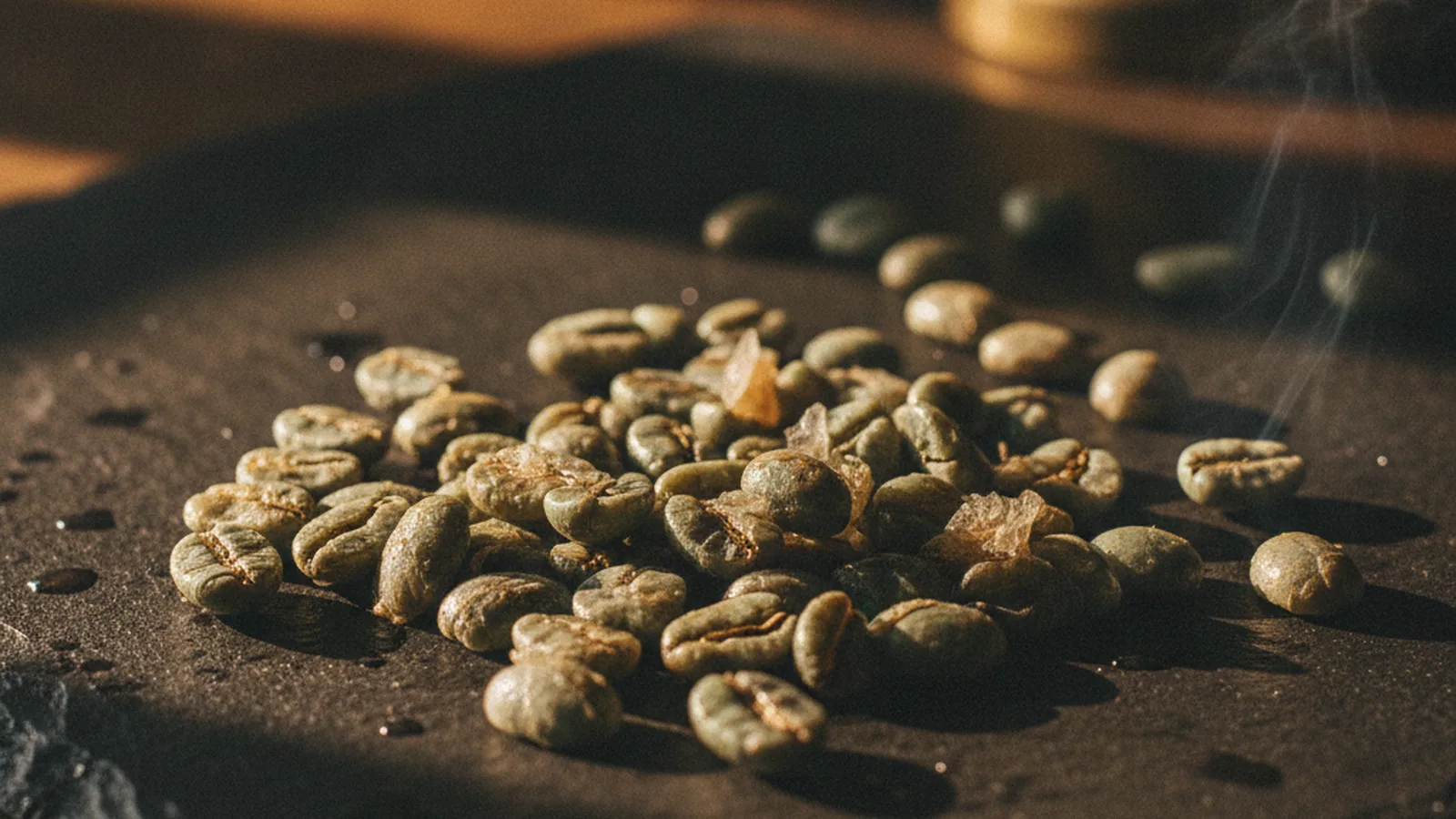
The mechanism is specific, not just an adjective. Cherries are pulped and briefly fermented, the same first steps as a washed process, but instead of drying the parchment down to the usual 10-12% moisture, farmers stop after only a few hours in the sun, at a still-damp 35-50%. At that moisture, a huller strips the swollen, soft parchment directly off the green bean, a step Cafe Imports notes leaves the bean itself, still wet, exposed through the final open-air drying that finishes it. That early exposure produces Sumatra’s signature look, a bluish-green, twisted bean, and its signature cup: heavy body, low acidity, and an earthy, herbal character that reads as a flaw to some drinkers and as the whole point to others.
The two Coffee Review lots behind this entry’s flavor profile land on different points of that spectrum. Revel Coffee’s 2023 Karo Highlands lot, a Tim Tim, Catimor, and Lasuna mix, reads sweetly earthy with pipe tobacco, jasmine, and a grapefruit-zest brightness; the older, lighter-roasted Terroir Select lot from Lintong leans cherry and unsweetened chocolate with the same jasmine-like floral note. Both sit well above the wider spread of Sumatra Mandheling reviews on Coffee Review, which runs from the low 70s to low 90s depending on the roaster and how cleanly the wet-hulling and drying were executed, a reminder that this label describes a processing category as much as an origin, and execution varies as much as terroir does.
How to brew it
Method fit for this origin · editorial guidance from roaster convention
Low acidity and heavy, syrupy body hold up well under pressure brewing, one reason Sumatra shows up so often as an espresso-blend base for body and crema.
Full immersion matches the heavy body wet-hulling produces without needing to showcase acidity this coffee was never built around.
Doable with lighter-roast, cleaner-cupping lots, but roasters more often reach for immersion methods to match this origin's weight rather than filter for clarity it doesn't emphasize.
⚠ Fit tiers are editorial guidance drawn from roaster convention; no industry standard scores brew fit, so we show tiers, never invented numbers. Reflects brew guidance commonly published by specialty roasters for wet-hulled Sumatran lots, not an SCA-defined standard.
Altitude & region
Growing elevation, meters above sea level · this entry vs comparison bands
Sumatra Mandheling's range is sourced directly from Indonesia Specialty Coffee's exporter origin page (see Sources & data). Ethiopia Yirgacheffe, Kenya AA, and Brazil Cerrado are shown for scale using the same typical origin bands already published on this site, not lot-specific measurements. Sumatra Mandheling grows meaningfully lower than the two washed African origins shown here and close to Brazil's low-altitude band, one reason its cup reads heavier and less acidic than high-grown washed coffee.
Caffeine content
Caffeine by dry weight · each gold dot = 0.1%
Caffeine content tracks species, not origin, altitude, or processing: roughly 1.2% for Arabica versus roughly 2.2% for Robusta, close to double (see Sources & data). This entry is 100% Arabica; no credible per-origin caffeine figure exists at a category level, so wet-hulling and this origin's comparatively low elevation do not make it more caffeinated than a washed, high-grown Arabica, despite the heavier body.
Where to buy it
Transparency: some links on this site are affiliate links; if you buy through them we may earn a commission at no cost to you. Roasters are picked for genuine, current sourcing of this coffee, never for who pays us.
Specialty importer and roaster with a long-running, dedicated Sumatra program; sells both a standard medium roast and a Mandheling Reserve dark roast.
View lot→Phoenix roaster sourcing a Takengon-area Mandheling lot through the Junus family's own mill, with control over processing end-to-end through export.
View lot→Queens, New York roaster with a standing Aceh-sourced Sumatra Mandheling in its single-origin rotation.
View lot→Hollywood, Florida micro-roaster; small-batch roasts a giling-basah-processed Sumatra to order, hand-sorted in three passes before roasting.
View lot→Wet-hulled Mandheling is widely stocked; check for recent roast dates, this profile fades fast.
View lot→Sources & data
- Indonesia Specialty Coffee (ISC): Mandheling coffee beans origin guideAltitude (1,100-1,500 m) across named Batak highland districts and the Oct-Mar main harvest window, from a Medan-based green coffee exporter
- Sucafina: Sumatra Mandheling Wet-Hulled offeringAceh Highlands sourcing at 1,300+ m, Catimor variety, and harvest windows, cross-checked against ISC's altitude range
- Espresso Coffee Guide: Sumatra Mandheling coffee beansBroader published altitude span (750-1,500 m), Catimor/Typica variety mix, and giling basah description
- Cafe Imports: Wet-Hulled ProcessGiling basah mechanism: parchment hulled at roughly 35-50% moisture rather than the usual 10-12%, and its effect on cup body and earthiness
- Coffee Review: Sumatra Karo Mandheling, Revel CoffeeCupping scores (1 of 2 averaged); Tim Tim, Catimor, and Lasuna variety, washed-and-wet-hulled processing for this specific lot
- Coffee Review: Sumatra Mandheling, Terroir Select CoffeesCupping scores (2 of 2 averaged); Lintong-area lot
- Coffee Review: scoring methodology1-10 attribute scale definition
- Crozier et al.: Espresso coffees, caffeine and chlorogenic acid intake (Food & Function, 2012)Peer-reviewed (Univ. of Glasgow): states robusta coffee beans contain almost twice as much caffeine as arabica, by species (no percentage figures given in this paper)
- Development of a fast and simple method to identify pure Arabica coffee and blended coffee by Infrared Spectroscopy (J. Food Sci. Technol., 2021, PMC8292507)Peer-reviewed, open-access: "Arabica beans usually presents 1.0 to 1.5% w.w-1 of caffeine and Robusta beans presents 2.0 to 2.5% w.w-1" (quoted verbatim, source's own wording) -- source for this entry's 1.2% Arabica / 2.2% Robusta figures, both within the stated ranges