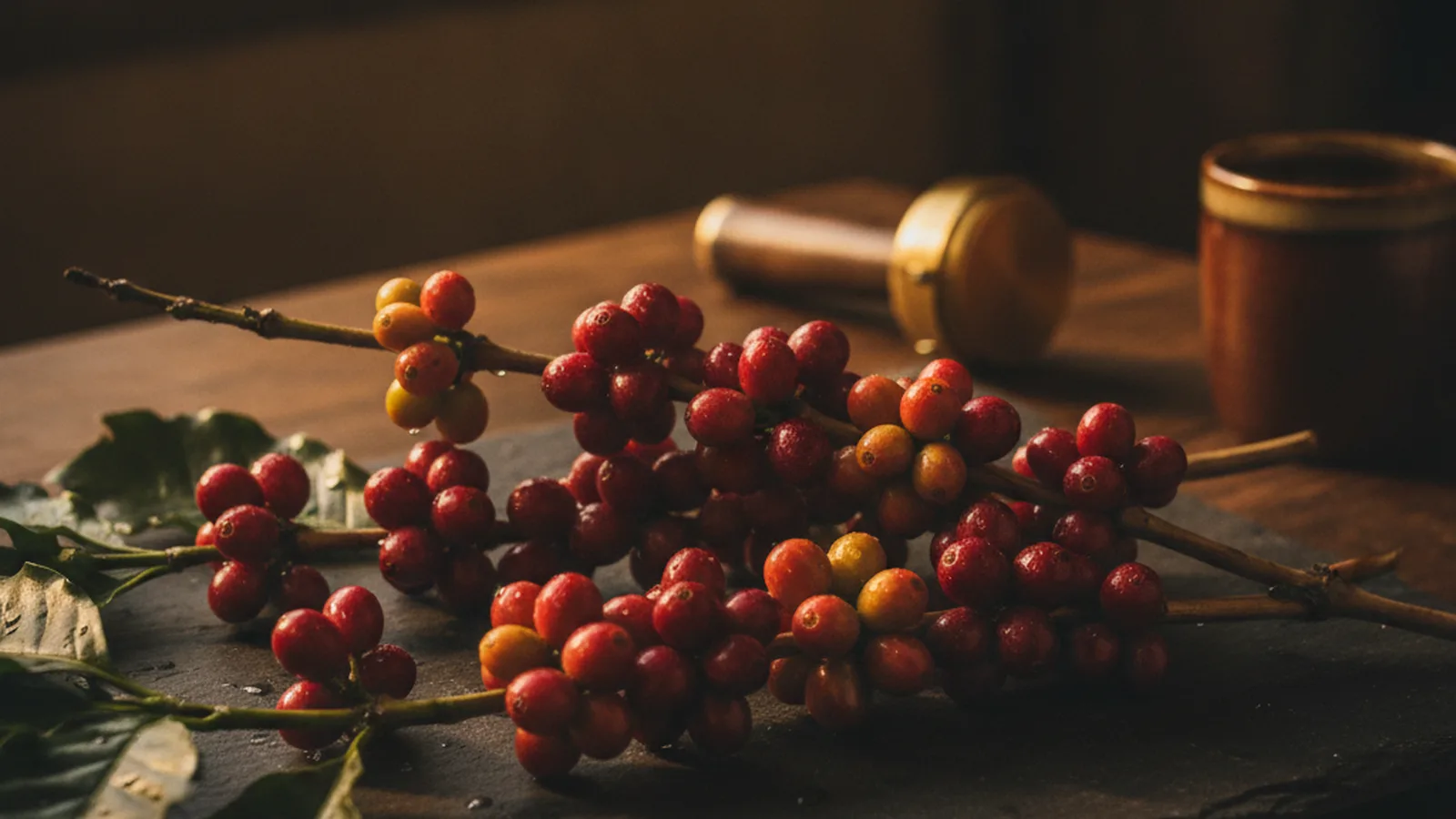
Image: Caffeine & Co studio
The Coffee Atlas
SL28 and SL34 Coffee Varieties
SL28 and SL34 are Kenya's 1935-39 Scott Labs selections: the real history, the genetics, and drought-tolerance evidence weighed against the lore.
Flavor profile
avg. of 3 published reviewsScale: 1-10, Coffee Review / SCA-classic-form convention. Averaged from 3 independently published, dated Coffee Review scores of single-variety SL28 or SL34 lots, not the Kenya-lot averages already used on this site's Kenya AA entry: Wilton Benitez SL-28 (JBC Coffee Roasters, Cauca, Colombia), Laura's Reserve SL34 (Hula Daddy Kona Coffee, Hawaii), and Kona SL34 Peaberry (Paradise Roasters, Hawaii). All three are exceptional, competition-grade microlots grown well outside Kenya, chosen because each publishes a full attribute breakdown for this specific variety. Not a typical commercial-lot score, and not a Kenya-specific sample: it shows what the two varieties can do now that they are planted well beyond their birthplace.
What it tastes like
SL stands for Scott Labs, short for Scott Agricultural Laboratories, a British colonial research station founded in 1922 at Kabete, outside Nairobi. Under agronomist A.D. Trench, the lab ran a systematic varietal selection program through the 1930s: evaluate Kenya’s existing coffee trees, propagate the best individual performers, and release the winners to farmers under an SL number. Podium Coffee Club’s history of the program puts the catalog at SL01 through SL45, with SL28 and SL34 among the selections officially released to growers in the late 1930s and 1940s.
The two varieties come from different trees and, it turns out, different genetic families, despite decades of roasters lumping them together as “Kenya’s two great varieties.” SL28 was selected in 1935 from a single standout tree in a population literally named Tanganyika Drought Resistant, imported from what is now Tanzania; World Coffee Research classifies its background as Bourbon-like. SL34 came a few years later from one tree on the Loresho Estate in Kabete, a tree labeled “French Mission” for its descent from Bourbon seed that French missionaries had carried to Kenya decades earlier, and for years it was assumed to share SL28’s Bourbon lineage. Homegrounds’ SL34 profile reports that more recent genetic testing overturned that assumption: SL34 actually groups with Typica, not Bourbon, making the two most-planted Kenyan varieties genetically distinct cousins rather than siblings.
SL28’s drought-tolerant reputation is the part of the story that gets repeated as settled fact, and the origin story is real: it was selected, by name, from a population bred for exactly that trait. But the direct evidence is thinner than the lore suggests. A 2014 peer-reviewed seedling trial in Zimbabwe put SL28 through 21 and 28 days of induced soil moisture deficit alongside three other varieties, including CR95, and found SL28 accumulated the least total dry biomass of the four under sustained drought stress, the opposite of a clear win. That is one trial, at the seedling stage, outside Kenya, and it says nothing about how a mature SL28 tree’s root system performs in its home highlands, so it does not overturn the origin story so much as complicate it: a coffee variety literally selected for drought resistance in 1935 did not automatically prove itself the most drought-tolerant option in a controlled modern trial. Both varieties also carry a real agronomic cost for that heritage cup quality: World Coffee Research rates both susceptible to coffee leaf rust, coffee berry disease, and nematodes, part of why disease-resistant hybrids like Ruiru 11 and Batian exist alongside them in Kenya today.
None of that has slowed the varieties’ spread. SL28 and SL34 are no longer just Kenyan: growers in Colombia, Hawaii, and Taiwan now plant both, chasing the same fruit-forward, structured cup. Colombian producer Wilton Benitez’s SL-28, put through an anaerobic and ultrasound process, scored 96 points from Coffee Review with passionfruit and orange blossom notes, while Hula Daddy’s Kona-grown Laura’s Reserve SL34 scored 98, among the highest marks Coffee Review has given any coffee, on black cherry, dark chocolate, and gardenia. That is the variety, not the place, carrying the cup.
How to brew it
Method fit for this origin · editorial guidance from roaster convention
Filtered clarity is what roasters reach for first on both varieties, letting the fruit-forward acidity that built Kenya's reputation come through clean.
Popular for fruit-forward single-origin shots, but the high acidity of well-grown SL28/SL34 needs a shorter, hotter dial-in to avoid sourness.
Full immersion adds body but mutes the bright, wine-like acidity that is the main reason roasters seek these varieties out.
⚠ Fit tiers are editorial guidance drawn from roaster convention; no industry standard scores brew fit, so we show tiers, never invented numbers. Reflects brew guidance commonly published by specialty roasters for high-acidity SL28/SL34 lots, not an SCA-defined standard.
Caffeine content
Caffeine by dry weight · each gold dot = 0.1%
Caffeine content tracks species, not variety, origin, altitude, or processing: roughly 1.2% for Arabica versus roughly 2.2% for Robusta, close to double (see Sources & data). SL28 and SL34 are both 100% Arabica cultivars; the genetics that shape their cup character do not extend to a credible per-variety caffeine figure at a category level.
Where to buy it
Transparency: some links on this site are affiliate links; if you buy through them we may earn a commission at no cost to you. Roasters are picked for genuine, current sourcing of this coffee, never for who pays us.
Madison, Wisconsin roaster whose Wilton Benitez SL-28 (Cauca, Colombia) scored 96 points from Coffee Review in June 2026.
View lot→Kona, Hawaii grower-roaster whose Laura's Reserve SL34 scored 98 points from Coffee Review, one of its highest-ever ratings.
View lot→Hilo, Hawaii roaster whose Kona SL34 Peaberry scored 96 points from Coffee Review in March 2026.
View lot→Long-running direct-relationship sourcing in Kenya's central highlands, rotating named SL28/SL34-driven washed lots.
View lot→SL28/SL34 lots surface from many roasters and origins; check the specific farm or importer naming, since the variety no longer means Kenya alone.
View lot→Sources & data
- World Coffee Research: SL28 variety profileSL28's 1935 selection from the Tanganyika Drought Resistant population, Bourbon-like genetic background, low yield, and susceptibility to leaf rust, coffee berry disease, and nematodes
- World Coffee Research: SL34 variety profileSL34's late-1930s selection, its Typica-related (not Bourbon-related) genetic classification per recent genetic testing, exceptional high-altitude cup quality, and disease susceptibility
- Podium Coffee Club: The History of the SL28 Coffee VarietalScott Agricultural Laboratories founded 1922 at Kabete under A.D. Trench; the SL01-SL45 selection catalog; SL28 and SL34 officially released to Kenyan growers in the late 1930s and 1940s
- Homegrounds: SL34 Coffee, A Kenyan Cultivar With Incredible PotentialSL34's selection from a single French Mission coffee tree on the Loresho Estate in Kabete, and the more recent genetic testing pointing to Typica rather than Bourbon parentage
- Ozone Coffee UK: SL28 Coffee: Kenya's Most Celebrated VarietyNotes World Coffee Research classifies SL28's genetic background as not fully resolved, and that some research points to possible Sudan Rume ancestry alongside Bourbon, an unconfirmed but published hypothesis, not this entry's own claim
- Chemura, Mahoya, Chidoko & Kutywayo: Effect of Soil Moisture Deficit Stress on Biomass Accumulation of Four Coffee (Coffea arabica) Varieties in Zimbabwe (ISRN Agronomy, 2014)Peer-reviewed seedling-stage drought trial (21 and 28 days of induced moisture deficit): SL28 accumulated the least total dry biomass of the four varieties tested (CR95, SL28, Cat128, Cat129), with CR95 significantly outperforming it, direct evidence complicating the simple 'SL28 is the drought-tolerant one' narrative
- Coffee Review: Wilton Benitez SL-28, JBC Coffee RoastersCupping scores (1 of 3 averaged)
- Coffee Review: Laura's Reserve SL34, Hula Daddy Kona CoffeeCupping scores (2 of 3 averaged)
- Coffee Review: Kona SL34 Peaberry, Paradise RoastersCupping scores (3 of 3 averaged)
- Coffee Review: scoring methodology1-10 attribute scale definition
- Crozier et al.: Espresso coffees, caffeine and chlorogenic acid intake (Food & Function, 2012)Peer-reviewed (Univ. of Glasgow): states robusta coffee beans contain almost twice as much caffeine as arabica, by species (no percentage figures given in this paper)
- Development of a fast and simple method to identify pure Arabica coffee and blended coffee by Infrared Spectroscopy (J. Food Sci. Technol., 2021, PMC8292507)Peer-reviewed, open-access: "Arabica beans usually presents 1.0 to 1.5% w.w-1 of caffeine and Robusta beans presents 2.0 to 2.5% w.w-1" (quoted verbatim, source's own wording), source for this entry's 1.2% Arabica / 2.2% Robusta figures, both within the stated ranges