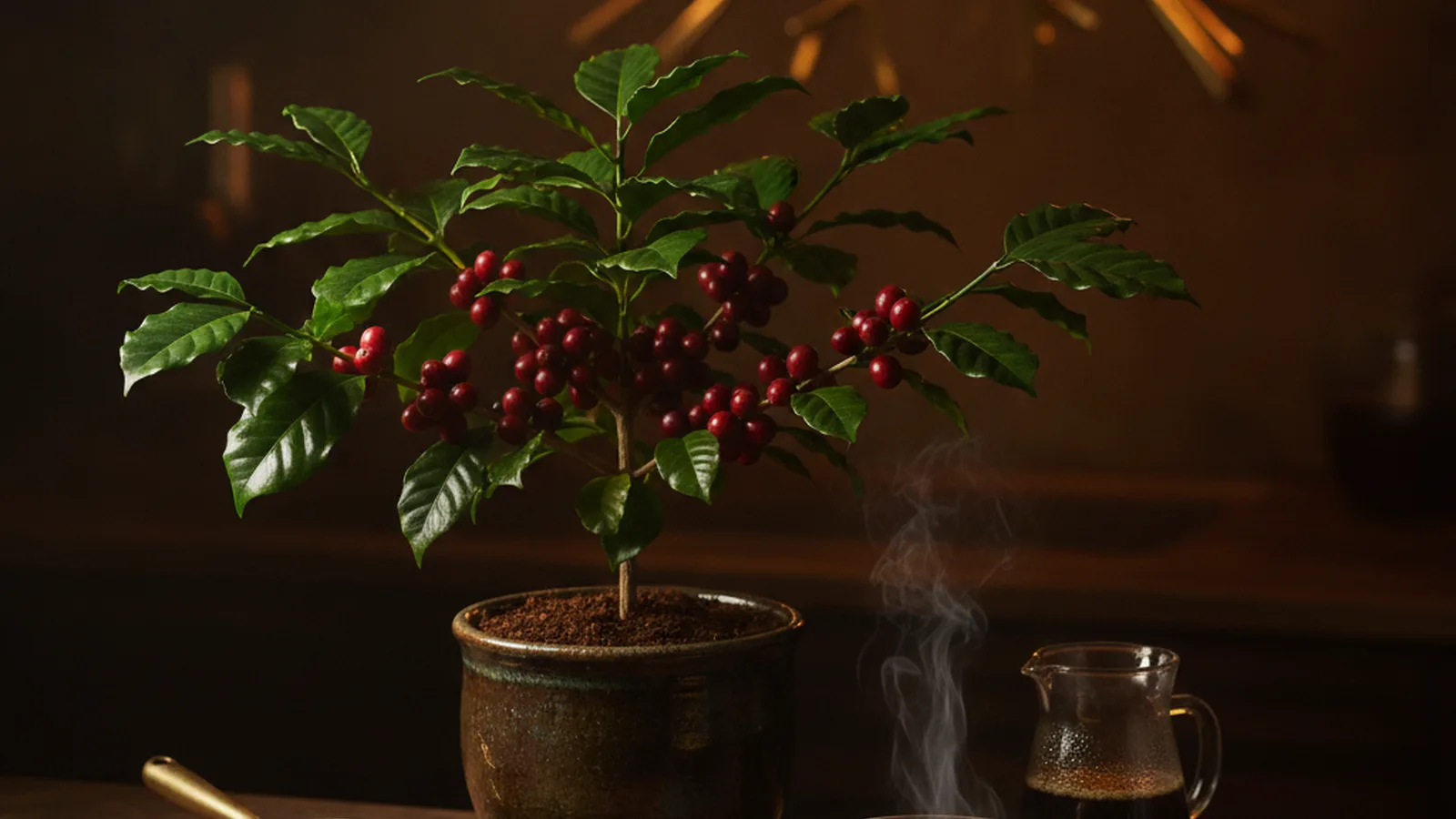
Image: Caffeine & Co studio
The Coffee Atlas
Pacamara Coffee
Pacamara is El Salvador's 30-year Pacas by Maragogipe cross: huge beans, real Cup of Excellence wins, and an honest look at how often the hype holds up.
Flavor profile
avg. of 2 published reviewsScale: 1-10, Coffee Review / SCA-classic-form convention. Averaged from 2 independently published, dated Coffee Review scores of El Salvador Pacamara lots: a natural-process Chalatenango lot and a black-honey Finca El Cerro lot. Not a category-wide statistical sample: individual Pacamara lots span from the high 80s (workaday commercial lots) to the mid 90s (competition-grade microlots), and the variety's own generational instability (see body) means cup quality varies more within Pacamara than within many single-origin categories.
What it tastes like
Pacamara is not a place, it is a cross. El Salvador’s Instituto Salvadoreno de Investigaciones del Cafe (ISIC) began combining Pacas and Maragogipe in 1958, chasing a plant with Pacas’ hardiness and Maragogipe’s outsized cup quality in one tree. Pacas itself is a 1949 Bourbon mutation discovered by Fernando Alberto Pacas Figueroa on Finca San Rafael, near the Santa Ana volcano: shorter, stockier, and higher-yielding than standard Bourbon. Maragogipe is an older Typica mutation out of Bahia, Brazil, prized for a huge bean and a bright, citrusy cup but planted by almost nobody because its yields run so low. Stabilizing the cross into a reliably true-breeding F5 generation took roughly 30 years; ISIC did not release Pacamara to growers until the late 1980s.
That instability never fully went away. World Coffee Research still rates Pacamara’s yield potential low and its leaf rust resistance low, and growers commonly report that something like 10 to 20 percent of offspring revert toward one parent instead of growing true to type. The payoff is the same oversized bean Maragogipe was chosen for in the first place: Pacamara beans run large and dense enough that most roasters drop their roast temperature and shrink batch size to keep the outside from scorching before the inside finishes drying out.
Pacamara accounts for roughly 2 percent of El Salvador’s coffee production, against 62 percent Bourbon and 31 percent Pacas, yet it punches far above that share at Cup of Excellence. In 2020, Roberto Vilanova’s natural anaerobic Pacamara took first place at 90.31 points, the first time an anaerobic-processed lot had won the competition in its 17-year history. The following year, Ever Leonel Diaz Perez’s semi-washed Pacamara from Finca Mileydi in Chalatenango tied for first at 91.68. The variety does not win every year anymore. Newer discoveries like the Geisha-related Bernardina variety have started sharing the podium, but no single cultivar shows up there as consistently as Pacamara.
In the cup, the two independently reviewed lots behind this profile lean fruit-forward and dense rather than delicate. Conscious Cup’s natural-process Finca Don Jaime scored 94 on tamarind, dark chocolate, wine barrel, and magnolia notes with a plush, syrupy body, while Red Rooster’s black-honey Finca El Cerro scored 93 on Concord grape, almond nougat, and roasted cacao nib. That combination, big body, winey acidity, and fruit that reads closer to a natural-processed origin coffee than a delicate varietal, is what separates Pacamara from lighter, more floral hybrids like Gesha.
How to brew it
Method fit for this origin · editorial guidance from roaster convention
Filtered brewing lets the dense body and fruit-forward acidity roasters prize in competition-grade Pacamara come through without muddying the complexity.
The big body works well under pressure, but the unusually large, dense beans roast unevenly if the profile is not adjusted, so dial-in matters more than usual.
Full immersion suits the heavier body, though it can flatten the winey acidity and floral top notes that define the best lots.
⚠ Fit tiers are editorial guidance drawn from roaster convention; no industry standard scores brew fit, so we show tiers, never invented numbers. Reflects brew guidance commonly published by specialty roasters for large-bean, high-body Pacamara lots, not an SCA-defined standard.
Caffeine content
Caffeine by dry weight · each gold dot = 0.1%
Caffeine content tracks species, not variety, origin, altitude, or processing: roughly 1.2% for Arabica versus roughly 2.2% for Robusta, close to double (see Sources & data). Pacamara is 100% Arabica; no credible per-variety caffeine figure exists at a category level, so the comparison above is by species only, not a measurement of this specific lot.
Where to buy it
Transparency: some links on this site are affiliate links; if you buy through them we may earn a commission at no cost to you. Roasters are picked for genuine, current sourcing of this coffee, never for who pays us.
Crystal Lake, Illinois roaster whose natural-process El Salvador Finca Don Jaime Pacamara scored 94 points from Coffee Review in December 2024.
View lot→Antigua, Guatemala roaster and farm that rotates several named Pacamara lots, including its own Fincas Las Moritas microlots.
View lot→San Diego small-batch roaster whose natural-process Guatemala Finca La Bolsa Pacamara scored 95 points from Coffee Review in July 2025.
View lot→Virginia roaster with a rotating El Salvador Pacamara program, including its El Mirador lot.
View lot→Pacamara lots surface here from many roasters and origins; check the specific farm and processing naming, since quality varies more within this variety than most.
View lot→Sources & data
- World Coffee Research: Pacamara variety profileGenetic classification (Pacas x Maragogipe, Bourbon-Typica group), low yield potential, low leaf rust resistance, very large bean size, high-altitude quality potential, generational instability
- Ozone Coffee UK: Pacamara variety page1958 ISIC cross, roughly 30 years to a stable F5 generation, 10-20% of offspring reverting to a parent variety, roasting adjustments for large dense beans
- Perfect Daily Grind: Interview: What's So Special About Pacamara?ISIC development timeline and Pacas/Maragogipe parent traits (hardiness and yield vs. bean size and cup quality)
- Ozone Coffee UK: Pacas variety pagePacas discovered 1949 by Fernando Alberto Pacas Figueroa on Finca San Rafael near the Santa Ana volcano, a natural Bourbon mutation
- Perfect Daily Grind: Could El Salvador become a boutique coffee origin?Pacamara at roughly 2% of El Salvador's coffee production versus 62% Bourbon and 31% Pacas; Cup of Excellence performance; discovery of the related Bernardina variety
- Fresh Cup: A Bittersweet Cup of Excellence for El Salvador2020 El Salvador Cup of Excellence: Roberto Vilanova's natural anaerobic Pacamara placed first at 90.31 points, the first anaerobic-processed winner in the competition's 17-year history
- Cup of Excellence: El Salvador 2021 results2021 El Salvador Cup of Excellence: Ever Leonel Diaz Perez's semi-washed Pacamara from Finca Mileydi, Chalatenango, tied for first place at 91.68 points
- Coffee Review: El Salvador Finca Don Jaime, Conscious Cup Coffee RoastersCupping scores (1 of 2 averaged)
- Coffee Review: El Salvador Finca El Cerro Pacamara Black Honey, Red Rooster Coffee RoasterCupping scores (2 of 2 averaged)
- Coffee Review: scoring methodology1-10 attribute scale definition
- Crozier et al.: Espresso coffees, caffeine and chlorogenic acid intake (Food & Function, 2012)Peer-reviewed (Univ. of Glasgow): states robusta coffee beans contain almost twice as much caffeine as arabica, by species (no percentage figures given in this paper)
- Development of a fast and simple method to identify pure Arabica coffee and blended coffee by Infrared Spectroscopy (J. Food Sci. Technol., 2021, PMC8292507)Peer-reviewed, open-access: "Arabica beans usually presents 1.0 to 1.5% w.w-1 of caffeine and Robusta beans presents 2.0 to 2.5% w.w-1" (quoted verbatim, source's own wording), source for this entry's 1.2% Arabica / 2.2% Robusta figures, both within the stated ranges