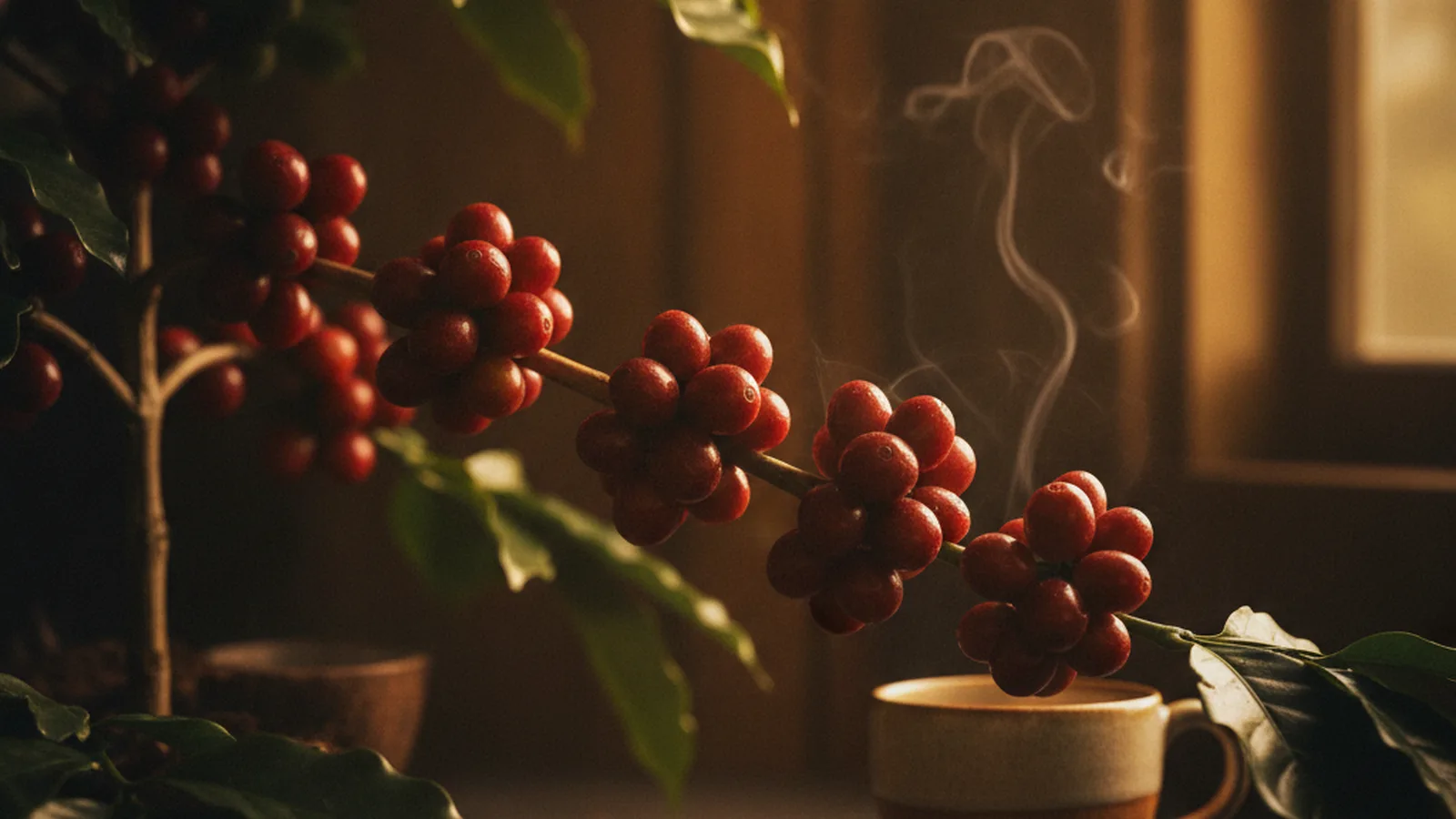
Image: Caffeine & Co studio
The Coffee Atlas
Maracaturra Coffee
Maracaturra crosses Maragogype giant bean with Caturra high yield: a Nicaragua bred hybrid with real Coffee Review scores and honest historical sourcing.
Flavor profile
avg. of 2 published reviewsScale: 1-10, Coffee Review / SCA-classic-form convention. Averaged from 2 independently published, dated Coffee Review scores of washed Maracaturra lots: a Guatemala Finca El Socorro lot and a Nicaragua Beneficio Santa Lucila lot, the variety's own country of origin. Not a category-wide statistical sample: Coffee Review has published roughly two dozen Maracaturra reviews, and since the cross has never been stabilized into a single true-breeding line, individual-farm variance runs higher than in a fixed-genetics variety.
What it tastes like
Maracaturra is one more branch off the same giant-bean family tree as Maragogype and Pacamara, but this one runs through Nicaragua rather than El Salvador. Coffee Review’s own account credits Byron Corrales of Finca Los Pinos, in the Arenal forest reserve outside Matagalpa, with developing the cross of Maragogype and Caturra that still carries his farm’s coffee into specialty lists today. Ozone Coffee’s variety history adds an official chapter to that story: Nicaragua’s state agricultural institute, INTA, began breeding selections from Maracaturra material in 1976, a program the Sandinista revolution left unfinished. Private producers picked up the selection work afterward, which is part of why the variety, unlike Pacamara, has never been stabilized into a single true-breeding line.
The cross keeps Maragogype’s oversized bean and Caturra’s shorter, high-yielding, wind-resistant growth habit, but it also inherits Caturra’s weak point: Maracaturra stays susceptible to coffee leaf rust and needs active management. Perfect Daily Grind’s reporting traces one path the variety took south of its home country, where El Salvador’s Mauricio Salaverria learned of it from Procafe’s Manuel Meza, who had seen it growing in Matagalpa, and planted it hoping for something more productive than either Maragogype or Pacamara. A Maracaturra lot took fifth place at Nicaragua’s 2015 Cup of Excellence, evidence the variety can cup well even without ever having been formally fixed.
The two independently reviewed lots behind this profile show that range rather than a single house style. Bear Lake Coffee’s washed lot from Guatemala’s Finca El Socorro scored 94 in February 2025 on dried peach, walnut, sugarcane, and baking chocolate, while Paradise Roasters’ Santa Lucila lot from Nicaragua, closer to the variety’s own home ground, scored 93 in January 2016 on lemon zest, almond, butterscotch, and rosemary flower. Both share the tart, syrupy structure and bright acidity roasters keep coming back to. Corrales’s own farm, at roughly 1,500 m in Matagalpa’s Arenal forest reserve, still grows Maracaturra for a handful of long-term buyers, an altitude in line with the high-elevation Central American farms where the variety’s better lots tend to come from.
How to brew it
Method fit for this origin · editorial guidance from roaster convention
Filtered brewing lets the bright acidity and fruit-forward top notes found in the best lots come through clean, without the body overwhelming them.
The naturally syrupy, full body suits full immersion, but it can mute the citrus and stone-fruit brightness that top lots are prized for.
Doable, but the unusually large, dense bean roasts unevenly unless the profile is slowed down, so dial-in matters more than with a standard-size bean.
⚠ Fit tiers are editorial guidance drawn from roaster convention; no industry standard scores brew fit, so we show tiers, never invented numbers. Reflects brew guidance commonly published by specialty roasters for large-bean Maracaturra lots, not an SCA-defined standard.
Caffeine content
Caffeine by dry weight · each gold dot = 0.1%
Caffeine content tracks species, not variety, origin, altitude, or processing: roughly 1.2% for Arabica versus roughly 2.2% for Robusta, close to double (see Sources & data). Maracaturra is 100% Arabica; no credible per-variety caffeine figure exists at a category level, so the comparison above is by species only, not a measurement of this specific lot.
Where to buy it
Transparency: some links on this site are affiliate links; if you buy through them we may earn a commission at no cost to you. Roasters are picked for genuine, current sourcing of this coffee, never for who pays us.
San Diego roaster and direct-trade partner of Finca El Socorro's Juan Diego de la Cerda since 2015; has repeatedly featured the farm's Maracaturra, most recently scoring 93 points from Coffee Review in May 2023.
View lot→Antigua, Guatemala roaster and farm that rotates several named Guatemalan Maracaturra lots, including Finca Retana and Finca Huixoc, both scored by Coffee Review.
View lot→Kansas roaster with a recurring Finca El Socorro Maracaturra program; its washed lot scored 92 points from Coffee Review in 2014.
View lot→Selection is thin for a true niche variety; confirm the listing actually names Maracaturra (not just large bean), then check roast dates and seller reviews before buying.
View lot→Sources & data
- Ozone Coffee UK: Maracatu (Maracaturra) variety pageGenetic parentage (Maragogipe x Caturra), Nicaragua's INTA began breeding selections in 1976, program left unfinished after the Sandinista revolution, private producers continued selection, never fully stabilized, leaf rust susceptibility, compact tree form
- Coffee Review: Big-Bean Coffee Varieties: Novelty, Scarcity, and Atypical Sensory PleasuresStates Maracaturra was developed in Nicaragua by Byron Corrales at Finca Los Pinos; November 2018 tasting report of 75 big-bean (Maragogipe, Pacamara, Maracaturra) samples for category-wide score-spread context
- Thanksgiving Coffee Company: Byron Corrales farmer profileFinca Los Pinos location (Arenal Forest Reserve, Matagalpa, Nicaragua), altitude approximately 1,500 m, buying relationship with Corrales since 1999, Maracaturra developed and grown exclusively by Corrales
- Perfect Daily Grind: Maracaturra: Why a CoE-Winning Farm Grows Hybrid VarietalsEl Salvador's Mauricio Salaverria learning of the variety from Procafe's Manuel Meza, who had seen it growing in Matagalpa, Nicaragua; leaf rust susceptibility; fifth place at Nicaragua's 2015 Cup of Excellence
- Coffee Review: Guatemala El Soccoro Maracaturra Washed, Bear Lake CoffeeCupping scores (1 of 2 averaged); February 2025, 94 points
- Coffee Review: Nicaragua Santa Lucila Maracaturra, Paradise RoastersCupping scores (2 of 2 averaged); January 2016, 93 points
- Coffee Review: scoring methodology1-10 attribute scale definition
- Development of a fast and simple method to identify pure Arabica coffee and blended coffee by Infrared Spectroscopy (J. Food Sci. Technol., 2021, PMC8292507)Peer-reviewed, open-access: "Arabica beans usually presents 1.0 to 1.5% w.w-1 of caffeine and Robusta beans presents 2.0 to 2.5% w.w-1" (quoted verbatim, source's own wording), source for this entry's 1.2% Arabica / 2.2% Robusta figures, both within the stated ranges