Image: Caffeine & Co studio
The Coffee Atlas
Kopi Luwak
Kopi luwak is coffee digested by the Asian palm civet: the real fermentation mechanism, the caged-civet fraud problem, and sourced cupping scores.
Flavor profile
avg. of 2 published reviewsScale: 1-10, Coffee Review / SCA-classic-form convention. Averaged from 2 independently published, dated Coffee Review scores: a standard Sumatra Arabica lot from Luwak Coffee (December 2007) and an explicitly wild-sourced Sumatra lot from The Bantuan Coffee Foundation (December 2013). Not a category-wide statistical sample: Coffee Review's own kopi luwak archive spans roughly the mid-80s to low-90s across different roasters, roast levels, and wild-versus-caged sourcing. A third reviewed lot (Animalcoffee's dark roast, 87 overall, December 2007) sits inside that range and is cited for context but was not averaged in, since its published scores omitted an Acidity figure.
What it tastes like
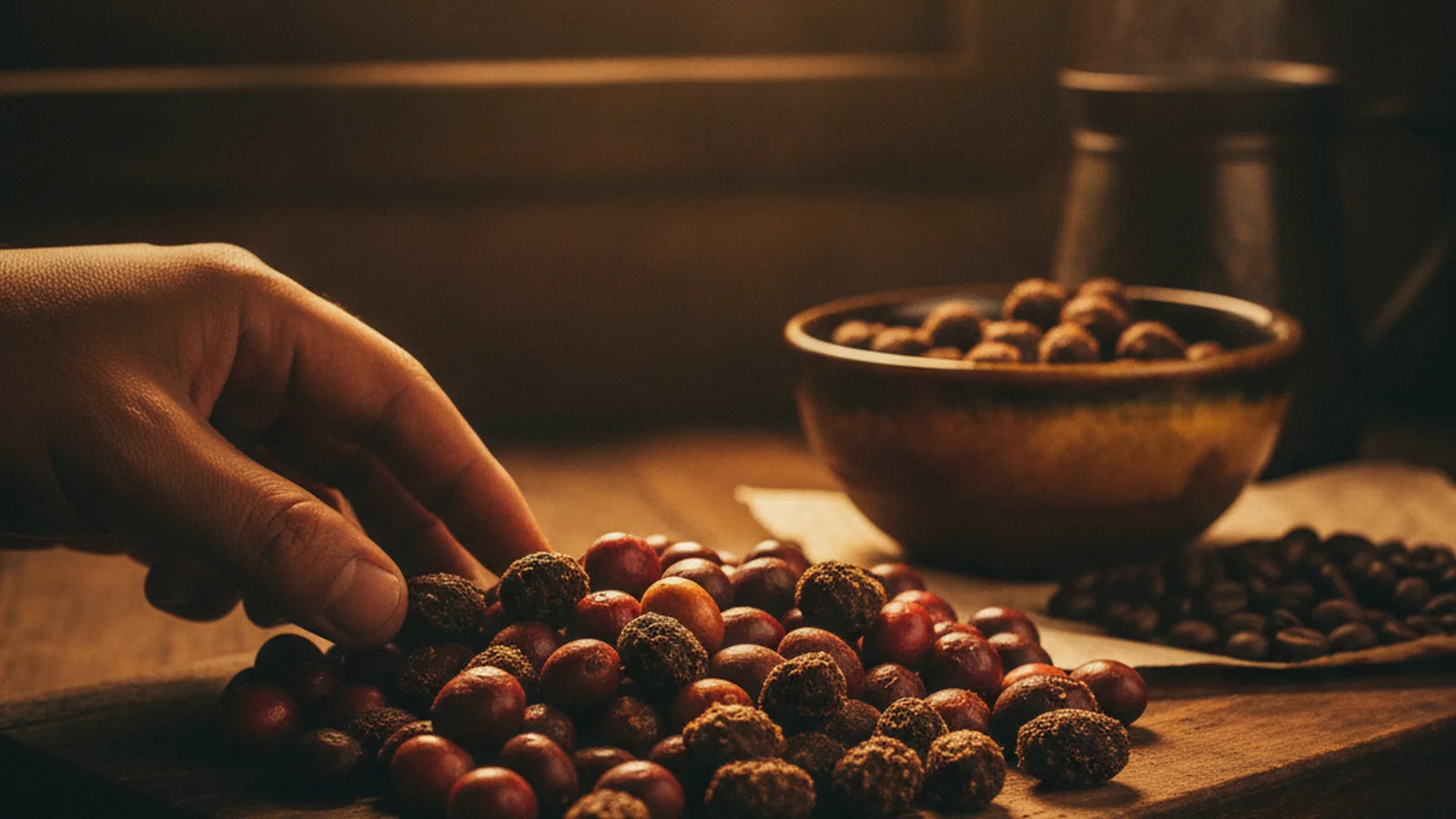
Kopi luwak is not a growing region or a varietal: it is coffee cherries that have already been eaten once, by an Asian palm civet. The civet swallows ripe cherries whole, and while its gut digests the fruit for nourishment, the beans inside pass through largely intact, exposed for roughly a day to a mix of digestive enzymes and gut bacteria. A peer-reviewed 2026 metagenomic and metabolomic study of Vietnamese civets documented real shifts in gut-microbial taxa and fecal metabolites consistent with partial fermentation, though the study’s own data does not itself measure protein breakdown in the beans; that specific mechanism, commonly repeated in the wider literature, traces to prior research cited in the study’s introduction, not to its own findings. Civet coffee’s characteristically lower acidity and bitterness are commonly attributed in the wider literature to a resulting drop in chlorogenic acids, though that specific chemistry was not itself measured by this study either. Farmers collect, wash, and dry the beans from the droppings before roasting them as normal. The practice traces back to Dutch-controlled plantations in 18th and 19th century Java and Sumatra, where colonial rules barred local workers from picking or keeping the coffee cherries they grew for export; beans gathered from civet droppings on the forest floor fell outside that rule, and what began as a loophole became the coffee’s origin story, according to one Indonesian green-coffee exporter’s account of the practice’s history.
The two named, dated Coffee Review lots behind this page’s flavor profile land on opposite ends of the same basic character. A standard Sumatra Arabica lot from Luwak Coffee reads sweet and soft, floral and orange-toned, undercut by a raw, slightly cloying nut note. An explicitly wild-sourced Sumatra lot from The Bantuan Coffee Foundation, whose sales fund anti-trafficking work in Indonesia, scores three points higher and reads richer: sandalwood, apricot, dark chocolate, plum blossom, musk, and a chanterelle-like mushroom note, finishing rounder. Coffee Review’s own kopi luwak archive runs from the mid-80s to the low-90s across different roasters, roast levels, and wild-versus-caged sourcing, a wide enough spread that no single score should stand in for the category.
That wild-versus-caged split is also the coffee’s real controversy, not a footnote to it. A 2016 peer-reviewed welfare study of 48 civets across 16 Bali coffee-tourism plantations found every caged operation failed basic welfare standards: wire-floor cages, filth, no natural substrate, restricted diets. National Geographic’s reporting on that study also cites a 2013 BBC undercover investigation that traced caged-civet coffee, mislabeled as wild-sourced, into major Western retailers, and quotes Tony Wild, the trader who, as coffee director at Taylors of Harrogate, first imported kopi luwak to the West in 1991, now warning buyers away from it entirely. No certification scheme currently verifies a wild-sourcing claim, so a “wild” label on a bag is a promise from the seller, not a guarantee.
Price is the other thing marketing tends to blur. None of this is really about the cup outperforming a good washed or natural coffee at a tenth the price: it is a novelty premium for a genuinely unusual process, and worth paying only to a roaster willing to say plainly where its civets actually live.
How to brew it
Method fit for this origin · editorial guidance from roaster convention
Filter brewing is the method most published kopi luwak guides point to, since a paper filter does not add extra body or bitterness on top of an already low-acid, mellow cup.
Full immersion is one of the most commonly published brewing methods for civet coffee, though the extra body it adds can mute the subtle musk-and-sandalwood complexity a filter keeps readable.
Workable, but none of the brewing guides reviewed for this entry recommend it specifically: concentrated extraction favors intensity over the low-acid subtlety that is the actual point of a civet-processed cup.
⚠ Fit tiers are editorial guidance drawn from roaster convention; no industry standard scores brew fit, so we show tiers, never invented numbers. Reflects brewing guidance commonly published across civet-coffee vendor and brewing guides, which converge on filter-drip and French press as the most-recommended methods; no source reviewed for this entry specifically discourages espresso, so it is marked workable rather than not recommended.
Caffeine content
Caffeine by dry weight · each gold dot = 0.1%
Caffeine content tracks species, not processing method: roughly 1.2% for Arabica versus roughly 2.2% for Robusta, close to double (see Sources & data). Kopi luwak is produced from both Arabica and Robusta cherries depending on the region, and Coffee Review has reviewed both separately. Gut fermentation changes proteins, sugars, and chlorogenic acids, not the bean's underlying caffeine content, so no credible per-batch caffeine figure exists at a category level; this page spans both species, so neither row above is marked as this coffee.
Where to buy it
Transparency: some links on this site are affiliate links; if you buy through them we may earn a commission at no cost to you. Roasters are picked for genuine, current sourcing of this coffee, never for who pays us.
West Java direct producer selling kopi luwak across several roast levels; publishes an explicit 100% wild-civet, no-cage claim tied to its own Pangalengan Highlands farm.
View lot→Long-running US specialty importer; sells a Sumatra, Sulawesi, and Java lot labeled Free Range Kopi Luwak, wild-gathered from uncaged civets, at a stated premium over caged-sourced competitors.
View lot→Aceh, Sumatra direct exporter working with dozens of local farmers on a stated wild, cage-free civet program; ask any seller for documentation before buying, given the industry's well-documented mislabeling problem.
View lot→Widest selection in one place, and where kopi luwak's fraud problem is worst: look for a named farm or exporter with an explicit wild-sourcing claim, not just a photo of a civet, and confirm it is 100% kopi luwak rather than a diluted blend.
View lot→Sources & data
- Coffee Review: Kopi Luwak Arabica, Medium Roast, Luwak CoffeeFull five-attribute cupping scores and tasting notes (1 of 2 averaged); reviewed December 2007, Sumatra origin
- Coffee Review: Arabica Wild Kopi Luwak, The Bantuan Coffee FoundationFull five-attribute cupping scores and tasting notes (2 of 2 averaged); reviewed December 2013, explicitly wild- rather than caged-sourced Sumatra lot
- Coffee Review: Kopi Luwak Arabica Dark Roast, AnimalcoffeeThird reviewed lot (87 overall, December 2007), cited for score-range context but not averaged in, since its published scores omit an Acidity figure
- Coffee Review: scoring methodology1-10 attribute scale definition
- Metagenomic and metabolomic analyses of fecal samples from civet-digested coffee in Vietnam (PeerJ, 2026)Peer-reviewed: documents the gut-microbiota and digestive-enzyme partial-fermentation mechanism via 16S rRNA sequencing and fecal metabolomics on Vietnamese civets. The chlorogenic-acid/acidity-bitterness link often attributed to this study is actually a citation in its own introduction to separate prior literature (Muzaifa, Hasni & Rahmi, 2019), not a finding of this study, which measures fecal metabolites rather than bean chemistry
- Carder, Proctor, Schmidt-Burbach & D'Cruze: The animal welfare implications of civet coffee tourism in Bali (Animal Welfare, 2016)Peer-reviewed welfare assessment of 48 caged civets across 16 Bali coffee-tourism plantations; source for the caging welfare findings and the wild-versus-caged distinction
- National Geographic: The Disturbing Secret Behind the World's Most Expensive CoffeeSynthesizes the Carder et al. welfare study and the 2013 BBC undercover mislabeling investigation; quotes Tony Wild, the trader who introduced kopi luwak to the West, warning against buying it; notes no certification scheme verifies wild-sourcing claims
- Discover Wildlife: Civet coffee: what it is, how it's made and why kopi luwak is considered a delicacyStates Tony Wild, as coffee director at Taylors of Harrogate, was the first person to import kopi luwak into the West, in 1991
- Espresso & Coffee Guide: Kopi LuwakProcess mechanism, producing countries (Sumatra as largest producer, also Vietnam and the Philippines), and species detail
- Espresso & Coffee Guide: Brewing Civet CoffeeSource for brewFit: filter-drip and French press listed as the most commonly published brewing methods for civet coffee
- FnB Coffee: Kopi Luwak OriginIndonesian green-coffee exporter's account of the Dutch colonial-era origin story: workers barred from keeping the cherries they grew, who found civet-passed beans fell outside that rule
- Kaya Kopi: Shop Kaya Kopi Luwak CoffeeRoaster listing and wild-sourcing claim (buy link); West Java Pangalengan Highlands region detail
- Volcanica Coffee: Kopi Luwak Coffee, Free Range, 16 oz.Roaster listing and free-range, wild-gathered sourcing claim (buy link)
- Wallacea Coffee: Wild Kopi Luwak CoffeeRoaster listing and wild-sourcing claim (buy link); Aceh, Sumatra origin detail
- Crozier et al.: Espresso coffees, caffeine and chlorogenic acid intake (Food & Function, 2012)Peer-reviewed (Univ. of Glasgow): states robusta coffee beans contain almost twice as much caffeine as arabica, by species (no percentage figures given in this paper)
- Development of a fast and simple method to identify pure Arabica coffee and blended coffee by Infrared Spectroscopy (J. Food Sci. Technol., 2021, PMC8292507)Peer-reviewed, open-access source for this entry's 1.2% Arabica / 2.2% Robusta caffeine figures, both within the paper's own stated ranges