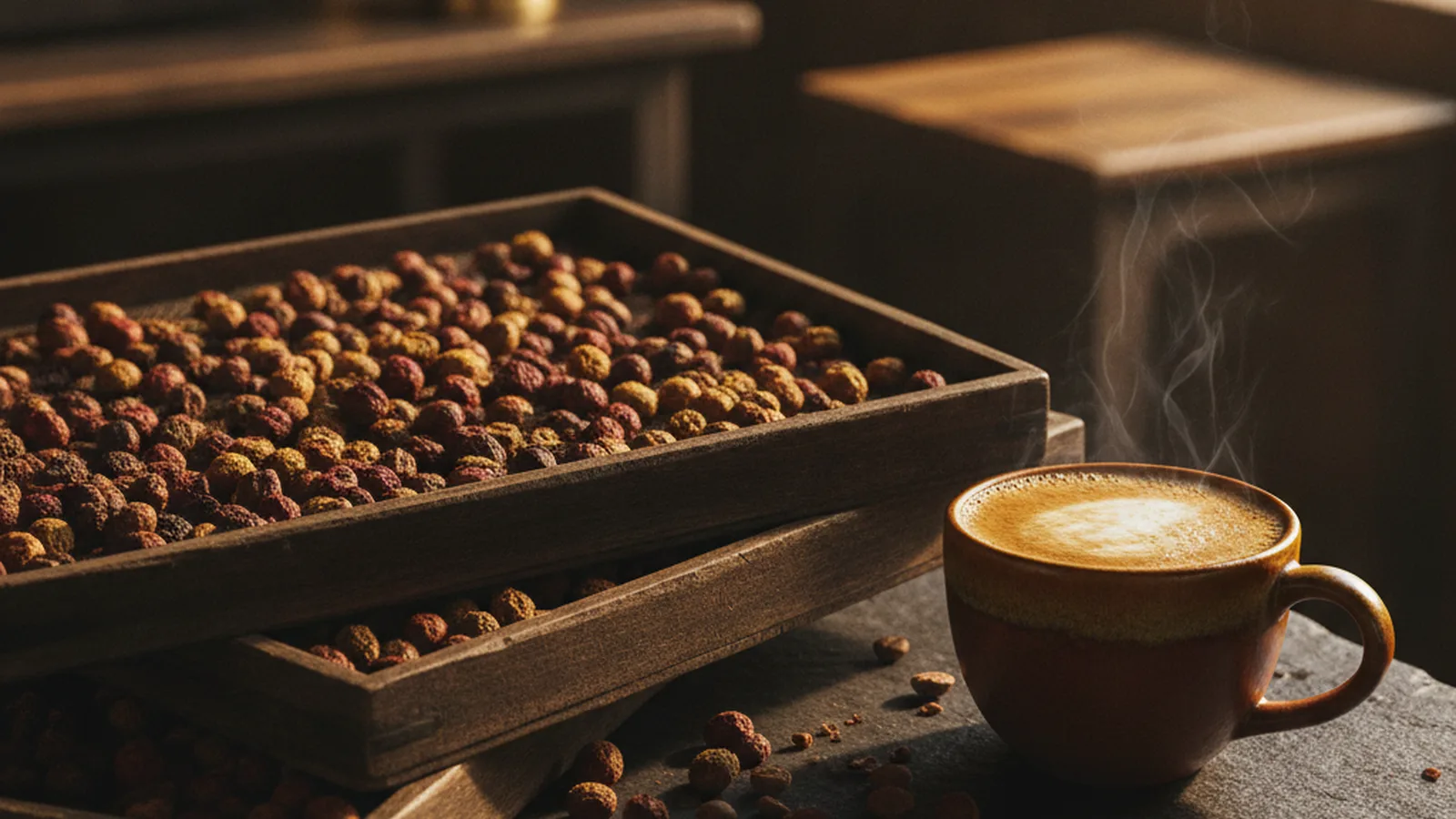
Image: Caffeine & Co studio
The Coffee Atlas
Monsooned Malabar Coffee
Monsooned Malabar trades acidity for body: raw beans absorb monsoon humidity on India's Malabar Coast for 12-16 weeks, with the real mechanism and cupping data.
Flavor profile
avg. of 2 published reviewsScale: 1-10, Coffee Review / SCA-classic-form convention. Averaged from 2 independently published, dated Coffee Review lot scores of Monsooned Malabar, both reviewed October 2009: Indian Monsooned Malabar (Julian Coffee Roasters) and Monsoon Medley (Josuma Coffee, whose own review text confirms it as monsooned, not a blend). Not a category-wide statistical sample: Coffee Review's own archive of this coffee spans roughly 80 to 91 across separately reviewed lots since 1998, and several of those older reviews record Acidity as literally 'Very Low' rather than a number, or omit an Acidity score altogether, a real reflection of how thoroughly monsooning flattens this attribute versus washed or natural coffees.
What it tastes like
Monsooned Malabar exists because of a shipping accident. Coffee sailing from India’s Malabar Coast to Europe on wooden ships once spent months crossing open ocean, and the salt air and sea humidity swelled the green beans and softened their acidity along the way. European buyers came to expect that flavor, and when steamships cut the voyage down to weeks, producers had to recreate the effect on land instead, as mtpak.coffee’s roasting guide explains.
The modern process runs during the actual Southwest monsoon, June through September: dry-processed beans go into open-sided warehouses on the coast between Karnataka and Kerala, spread in thick layers, and left to absorb moisture-laden sea winds for 12 to 16 weeks, with regular raking to keep the exposure even, per Inter-American Coffee’s origin page. Indian Coffee Beans’ explainer puts numbers on the change: beans start around 12% moisture and finish closer to 14-15%, swelling toward nearly double their size and fading from green to pale gold. One industry account of the underlying chemistry describes a slow oxidation of the organic acids naturally present in green coffee, citric, malic, and phosphoric, substantially reduced over those weeks, the real mechanism behind the flattened acidity every taster notices, per Zenforest Coffee’s explainer.
Monsooned Malabar was the first coffee variety in India to receive Geographical Indication protection, according to a peer-reviewed case study in the Journal of Intellectual Property Rights; the GI, administered by the Coffee Board of India, restricts the name to beans processed on the Malabar Coast between Mangalore and Kozhikode. The two Coffee Review lots behind this page’s flavor profile both scored in the high 80s in the same October 2009 batch of reviews: Julian Coffee Roasters’ Indian Monsooned Malabar reads raisin and dark chocolate over aromatic wood, while Josuma Coffee’s Monsoon Medley reads caramel and fruit ferment over the same woody backbone. Both landed an Acidity score of 7, itself unusually high for this style: several older Coffee Review lots of the same coffee record Acidity as literally “Very Low” rather than a number at all.
That flattened acidity is also why Monsooned Malabar’s home is pressure and immersion brewing rather than a filter cone. Sweet Maria’s own lot notes recommend it primarily for espresso blending over standalone brewing, and Zenforest’s brew-method breakdown rates espresso and French press as its two best fits, precisely because both let the heavy body and cocoa-and-spice register carry the cup without needing the bright acidity a pour-over is built to showcase.
How to brew it
Method fit for this origin · editorial guidance from roaster convention
Sweet Maria's own lot notes recommend this coffee primarily for espresso blending over standalone brewing: the flattened acidity reads as depth rather than sourness under pressure.
One industry brewing breakdown rates French press alongside espresso as this coffee's two best-suited methods, since full immersion carries the heavy body and cocoa-and-spice register well.
Monsooning exists specifically to strip out brightness and acidity, the exact qualities a filtered pour-over is built to showcase, so this is the weakest match of the three.
⚠ Fit tiers are editorial guidance drawn from roaster convention; no industry standard scores brew fit, so we show tiers, never invented numbers. Reflects brewing guidance published by Sweet Maria's own lot listing and one specialty roaster's brew-method breakdown for monsooned coffee, not an SCA-defined standard.
Altitude & region
Growing elevation, meters above sea level · this entry vs comparison bands
Monsooned Malabar's own range is sourced directly from Sucafina's and Inter-American Coffee's Malabar Coast origin listings (see Sources & data). Ethiopia Yirgacheffe, Kenya AA, and Brazil Cerrado are shown for scale using the same commonly published origin altitude bands already used elsewhere in this Atlas, not a lot-specific measurement. Note this is growing altitude, not the separate warehouse process that gives this coffee its name: monsooning happens at sea level on the coast after harvest, regardless of how high the cherries themselves were grown.
Caffeine content
Caffeine by dry weight · each gold dot = 0.1%
Caffeine content tracks species, not processing method: roughly 1.2% for Arabica versus roughly 2.2% for Robusta, close to double (see Sources & data). Monsooned Malabar is produced as both an Arabica grade (AA/A) and a separate Robusta grade under the same Geographical Indication, so neither species row above is marked as this coffee: the 12-16 week monsooning process changes the moisture, acids, and color of whichever bean goes through it, not its underlying caffeine content.
Where to buy it
Transparency: some links on this site are affiliate links; if you buy through them we may earn a commission at no cost to you. Roasters are picked for genuine, current sourcing of this coffee, never for who pays us.
Home-roasting green coffee specialist; lists this AA-grade Malabar Coast lot with its own cupping notes, grading detail, and an explicit espresso-blending recommendation.
View lot→Pennsylvania roaster with a long-running Indian Monsoon Malabar listing, light-roasted, 100% Arabica Kents and Cauvery beans, and hundreds of customer reviews.
View lot→Kosher-certified roaster selling light-to-city roast Monsooned Malabar; a separate lot from this same roaster scored 89 points in a 2007 Coffee Review review.
View lot→Whitefish, Montana roastery; dark-roast Monsooned Malabar with cedar, spiced-nut, and cocoa tasting notes on its own listing.
View lot→Widest selection in one place; confirm listings actually name Monsooned or Monsoon Malabar rather than a generic Indian-coffee blend, and check the roast date.
View lot→Sources & data
- Coffee Review: Indian Monsooned Malabar, Julian Coffee RoastersFull five-attribute cupping scores and tasting notes (1 of 2 averaged); reviewed October 2009
- Coffee Review: Monsoon Medley, Josuma CoffeeFull five-attribute cupping scores and tasting notes (2 of 2 averaged); reviewed October 2009, review text confirms this is a monsooned single-origin lot, not a blend
- Sucafina: Monsooned Malabar AA offering pageGrowing region (Karnataka & Kerala), altitude (1,100-1,200 m), variety (Catimor, Caturra, Kent, S795), harvest window (Nov-Jan)
- Inter-American Coffee: India Monsooned Malabar origin pageIndependently corroborates altitude (1,100-1,200 masl), region (Karnataka, Western Ghats), and variety detail; describes the 12-16 week warehouse process and bean handling
- Indian Coffee Beans: What is Monsooned Malabar Coffee? Process, Flavor & GradesGI protection detail restricting the name to beans processed on the Malabar Coast between Mangalore and Kozhikode; moisture percentages (starting ~12%, finishing ~14-15%) and grading tiers
- Journal of Intellectual Property Rights: Implications of Geographical Indication on Indian Specialty Coffee, Monsooned Malabar Arabica Coffee case studyPeer-reviewed case study: Monsooned Malabar was the first coffee variety in India to receive GI protection, initiated by the Coffee Board of India; documents a post-GI export price premium
- Zenforest Coffee: Monsoon Malabar ExplainedProcess chemistry: describes monsooning as a slow oxidation that substantially reduces citric, malic, and phosphoric acids; rates espresso and French press as the two best-suited brew methods
- mtpak.coffee: Roasting Indian Monsoon Malabar coffee, a pocket guideColonial-era sailing-ship origin story and why the process was later replicated on land; roasting guidance (low charge temperature, careful heat past first crack)
- Sweet Maria's: India Monsoon Malabar lot listingDirect trader/vendor confirmation of AA grading, current sourcing, and an explicit recommendation toward espresso blending over standalone brewing
- Crozier et al.: Espresso coffees, caffeine and chlorogenic acid intake (Food & Function, 2012)Peer-reviewed (Univ. of Glasgow): states robusta coffee beans contain almost twice as much caffeine as arabica, by species (no percentage figures given in this paper)
- Development of a fast and simple method to identify pure Arabica coffee and blended coffee by Infrared Spectroscopy (J. Food Sci. Technol., 2021, PMC8292507)Peer-reviewed, open-access: "Arabica beans usually presents 1.0 to 1.5% w.w-1 of caffeine and Robusta beans presents 2.0 to 2.5% w.w-1" (quoted verbatim, source's own wording), source for this entry's 1.2% Arabica / 2.2% Robusta figures, both within the stated ranges