Image: Caffeine & Co studio
The Coffee Atlas
Costa Rica Turrialba
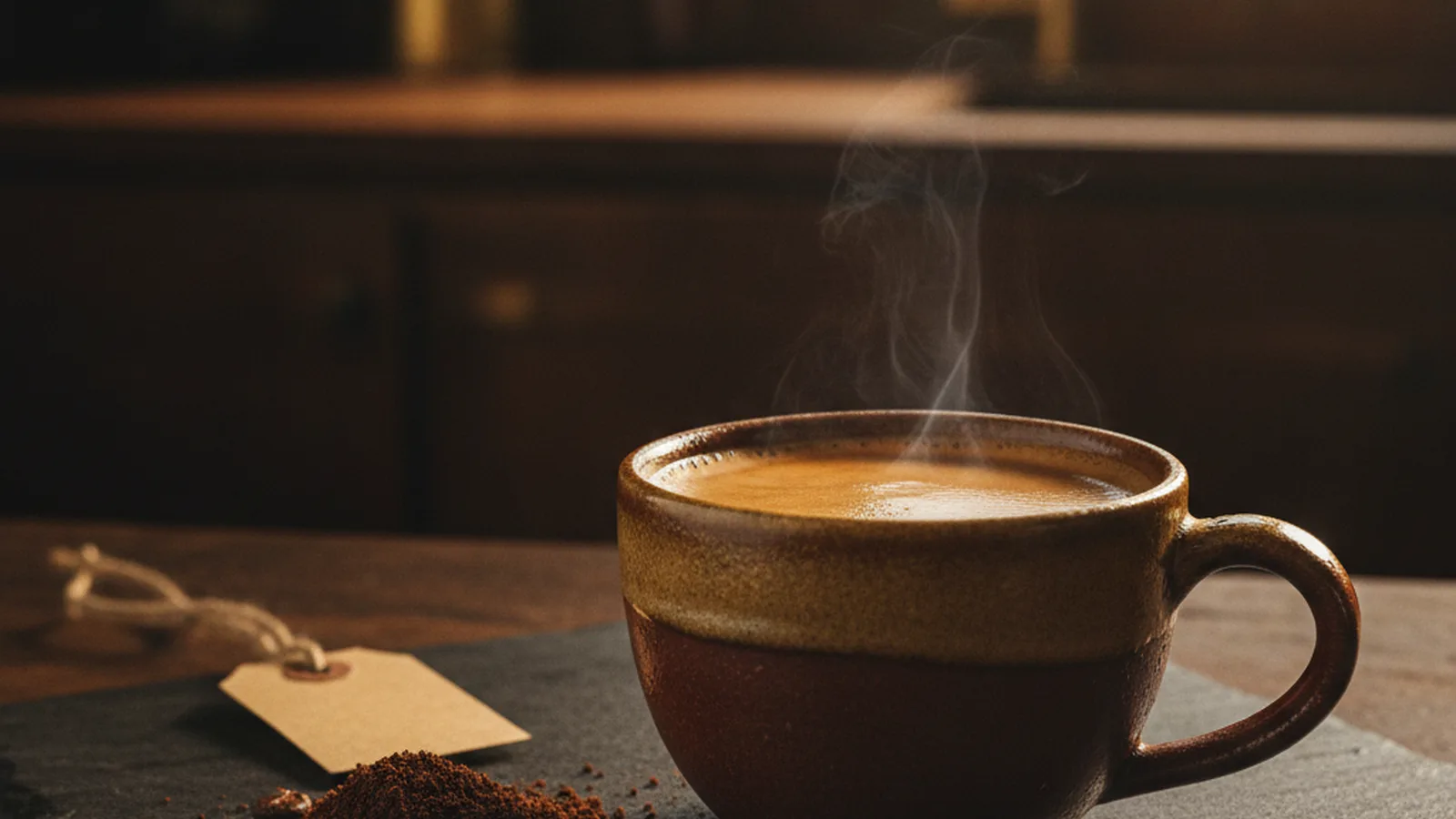
Costa Rica Turrialba, home to CATIE's coffee gene bank, where honey-processed microlots now outscore this low-altitude region's old, mild, everyday reputation.
Flavor profile
avg. of 2 published reviewsScale: 1-10, Coffee Review / SCA-classic-form convention. Averaged from the only 2 independently published, dated Coffee Review scores this research could find naming Turrialba as the growing region: a 1998 dark-roast lot (Dallis Bros. Coffee, Costa Rica Juan Vinas, overall 83; processing method not stated in the review) and a 2023 honey-processed microlot (Buon Caffe, Costa Rica Turrialba Volcano Honey Process, grown at Aquiares Farm, overall 94). The two are 25 years and one full processing method apart, and Coffee Review's own submission pool skews toward standout specialty lots rather than the everyday washed coffee that makes up most of this region's actual production, so this average likely reads higher than a typical cup from the zone. Small-N and individual-lot variance both apply on top of that skew.
What it tastes like
Turrialba is the exception to how this Atlas has described Costa Rica so far: an Atlantic-slope zone on the flanks of the Turrialba Volcano, growing coffee at 600 to 1,300 meters, a full highland band lower than Tarrazu, Tres Rios, or West Valley. Wikipedia’s regional comparison table, citing ICAFE’s own Turrialba page, rates the zone’s acidity as merely “Normal” and its body as “Little” against the “very good” to “excellent” it gives those higher, drier regions, and the roughly 8,500 hectares of Caturra and Catuai rojo grown here under legume shade trees have long supplied a milder, everyday-grade cup rather than a showcase one.
What the altitude doesn’t explain is why Turrialba matters to coffee science far beyond its own cup. The canton is home to CATIE’s international coffee collection, a germplasm bank holding over 1,000 coffee accessions and, per World Coffee Research, “the overwhelming bulk of genetic diversity available today outside of the Ethiopian forests.” Breeders drew a 97-accession core collection from it for exactly the kind of variety development that produced modern Costa Rican cultivars, and estates in the region, including Aquiares, now experiment with hybrids like Entre Rios alongside the traditional Caturra and Catuai base.
Aquiares itself, founded in 1890 on the volcano’s slopes, is Turrialba’s flagship: a washed-processing estate that has run continuously for over 130 years and now anchors most of the region’s specialty-grade exports. Its honey-processed microlots are also the clearest evidence that Turrialba’s “mild and everyday” reputation is a floor, not a ceiling. A 2023 Coffee Review lot of Aquiares honey-processed coffee scored 94, cupped as fruit-toned and syrupy with blackberry, brown sugar, dark chocolate, cedar, and star jasmine, a different coffee entirely from the plainer, dark-roast lot Coffee Review scored 83 back in 1998. Both are genuinely this region; the averaged flavor profile above sits between them, but Coffee Review’s own submissions skew toward the standout end, so treat that average as closer to what Turrialba can do than what most of its harvest actually tastes like.
How to brew it
Method fit for this origin · editorial guidance from roaster convention
Roasters carrying this origin's Aquiares Estate lots market them specifically for the shot; the milder acidity and fuller body that come with the region's lower growing altitude round out well under pressure.
This is a gentler, less acidic cup than Costa Rica's showcase highland regions, exactly the character a daily drip pot suits rather than needs to fight.
The honey-processed microlots show real complexity here, but the everyday washed coffee that makes up most of Turrialba's production doesn't carry the acidity clarity that makes pour-over the default choice elsewhere in this Atlas.
⚠ Fit tiers are editorial guidance drawn from roaster convention; no industry standard scores brew fit, so we show tiers, never invented numbers. Reflects brew guidance commonly published by specialty roasters carrying this origin's lots (its Aquiares Estate microlots are specifically marketed for espresso), not an SCA-defined standard.
Altitude & region
Growing elevation, meters above sea level · this entry vs comparison bands
Costa Rica Turrialba's range is sourced directly from ICAFE's own Turrialba region page (see Sources & data). Costa Rica Tarrazu, Costa Rica Tres Rios, and Brazil Cerrado are shown for scale using the same commonly published origin altitude bands already used elsewhere in this Atlas, not lot-specific measurements. Turrialba sits meaningfully lower than its own country's other showcase regions, which is the point of the comparison.
Caffeine content
Caffeine by dry weight · each gold dot = 0.1%
Caffeine content tracks species, not origin, altitude, or processing: roughly 1.2% for Arabica versus roughly 2.2% for Robusta, close to double (see Sources & data). Turrialba is grown as Arabica, the only species Costa Rican law permitted nationwide from 1998 until a restricted 2018 loosening confined to specific lower-altitude zones, not highland-tradition regions like Turrialba. No credible per-origin caffeine figure exists at a category level, so the comparison above is by species only, not a measurement of this specific lot.
Where to buy it
Transparency: some links on this site are affiliate links; if you buy through them we may earn a commission at no cost to you. Roasters are picked for genuine, current sourcing of this coffee, never for who pays us.
Sells a washed Entre Rios lot from Aquiares Estate, Turrialba's largest and oldest farm, roasted medium-light for espresso and filter.
View lot→Carries a washed Caturra lot from Aquiares Estate profiled specifically for espresso.
View lot→Sources a shade-grown Caturra lot direct from Turrialba's volcanic-slope agroforestry plots, roasted slightly dark for sweetness and body.
View lot→A thinner selection than Costa Rica's showcase regions; confirm the Turrialba or Aquiares naming and roast date before buying.
View lot→Sources & data
- Crozier et al.: Espresso coffees, caffeine and chlorogenic acid intake (Food & Function, 2012)Peer-reviewed (Univ. of Glasgow): states robusta coffee beans contain almost twice as much caffeine as arabica, by species (no percentage figures given in this paper)
- Development of a fast and simple method to identify pure Arabica coffee and blended coffee by Infrared Spectroscopy (J. Food Sci. Technol., 2021, PMC8292507)Peer-reviewed, open-access: Arabica beans usually present 1.0 to 1.5% w/w caffeine and Robusta beans present 2.0 to 2.5% w/w, source for this entry's 1.2% Arabica / 2.2% Robusta figures
- ICAFE: Region cafetalera TurrialbaCosta Rica's official coffee institute: Turrialba's topography (600-1,400 m) and coffee-specific planted altitude band (600-1,300 m), roughly 8,500 hectares of Caturra and Catuai rojo under legume shade (especially Laurel), volcanic and alluvial soils, average annual precipitation 2,600 mm, average annual temperature 21.5C, early-ripening Atlantic-slope climate
- Wikipedia: Coffee production in Costa RicaRegional comparison table, citing ICAFE's own Turrialba region page directly: highlighted altitude band (600-1,350 m), highlighted harvest window (Jun-Feb), and Turrialba's 'Normal' acidity, 'Little' body, and 'Good' aroma rating, a tier below the 'very good' to 'excellent' the same table gives Tarrazu, Tres Rios, and West Valley
- World Coffee Research: WCR/CATIE Core CollectionCATIE's germplasm bank in Turrialba holds over 1,000 coffee accessions and 'the overwhelming bulk of genetic diversity available today outside of the Ethiopian forests'; core collection of 97 genetically diverse accessions selected from nearly 1,000 for breeding use
- Aquiares: Our StoryAquiares Estate founding (1890), location on the slopes of Turrialba Volcano, washed-processing focus, farm-level altitude (820-1,400 m), and Rainforest Alliance certification since 2003
- Hub Coffee Roasters: Costa Rica Aquiares EstateEntre Rios hybrid varietal grown at Aquiares Estate alongside the region's traditional Caturra and Catuai
- Coffee Review: Costa Rica Turrialba Volcano Honey Process, Buon CaffeCupping scores and tasting notes (1 of 2 averaged)
- Coffee Review: Costa Rica Juan Vinas, Dallis Bros. CoffeeCupping scores and tasting notes (2 of 2 averaged)
- Coffee Review: scoring methodology1-10 attribute scale definition
- Costa Rica Star News: Costa Rica will lift ban for planting of Robusta coffee1998 national ban on Robusta cultivation, in force until a restricted 2018 loosening