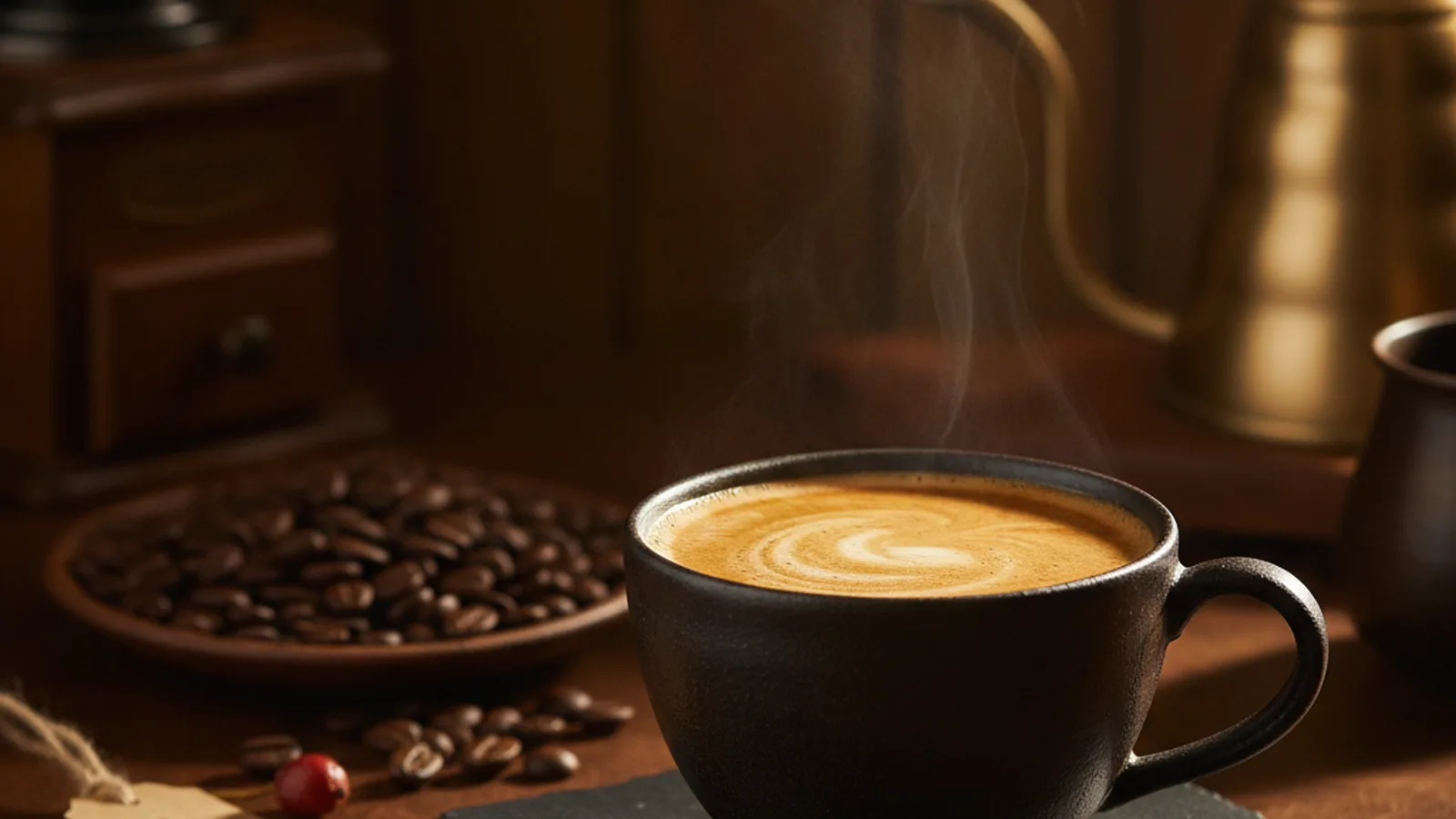
Image: Caffeine & Co studio
The Coffee Atlas
Costa Rica Tres Rios
Costa Rica Tres Rios, the small volcanic-soil district near San Jose known as the Bordeaux of Costa Rica, with a sourced flavor profile and real citations.
Flavor profile
avg. of 3 published reviewsScale: 1-10, Coffee Review / SCA-classic-form convention. Averaged from 3 independently published, dated Coffee Review scores of Tres Rios lots, each with a full five-attribute breakdown (Aroma, Flavor, Acidity, Aftertaste, Body). Not a category-wide statistical sample: the reviews span 2007 to 2011, and individual lots and roast levels vary.
What it tastes like
Tres Rios is a small coffee-growing district in La Union canton, Cartago Province, just east of San Jose, and it carries a reputation well out of proportion to its size: Costa Rica’s own coffee institute, ICAFE, calls it “the Bordeaux of Costa Rica,” a comparison it traces to the volcanic soil left by nearby Irazu. The zone’s coffee history goes back to 1820, when San Jose’s original coffee-growing area first expanded into the surrounding provinces, and cultivation here grew fastest through the 1840s.
The growing zone itself is compact and unusually uniform: ICAFE puts its farms between 1,200 and 1,650 meters, on tropical-acidity volcanic ash soils that hold moisture well and let coffee roots spread easily. That altitude band, combined with a well-defined wet and dry season, is enough to earn nearly all of the region’s crop Strictly Hard Bean grading, Costa Rica’s own classification for the dense, closed-fissure beans altitude-grown Arabica produces. Harvest runs August through February, coinciding with the dry season, and starts noticeably earlier than at higher-elevation Costa Rican zones like Tarrazu.
Farms here grow the same Caturra and Catuai varieties common across the Central Valley, mostly wet-processed and patio-dried, the way the COOPEUNION cooperative’s El Roble mill in Tres Rios itself handles its own lot. In the cup, three dated Coffee Review lots spanning 2007 to 2011 agree on the outline: orange and floral top notes, a chocolate and nutty body, and a sweetness that on at least one lot reads as molasses, with the acidity ICAFE’s own cupping notes call “very high and fine” giving the whole cup its lift.
How to brew it
Method fit for this origin · editorial guidance from roaster convention
Filtered clarity is the method roasters reach for first with washed Tres Rios lots, letting the orange and floral top notes the cited reviews describe come through unmuddied.
The medium-full body carries a shot reasonably well, but the very high, fine acidity ICAFE's own cupping notes describe for this zone needs careful dialling in to avoid sourness.
Full immersion suits the body, but tends to mute the floral lift and citrus brightness that define a good Tres Rios cup.
⚠ Fit tiers are editorial guidance drawn from roaster convention; no industry standard scores brew fit, so we show tiers, never invented numbers. Reflects brew guidance commonly published by specialty roasters for washed Costa Rican lots, not an SCA-defined standard.
Altitude & region
Growing elevation, meters above sea level · this entry vs comparison bands
Costa Rica Tres Rios' range is sourced directly from ICAFE's own Tres Rios regional page (see Sources & data). Costa Rica Tarrazu, Guatemala Antigua, and Brazil Cerrado are shown for scale using the same commonly published origin altitude bands already used elsewhere in this Atlas, not a lot-specific measurement.
Caffeine content
Caffeine by dry weight · each gold dot = 0.1%
Caffeine content tracks species, not origin, altitude, or processing: roughly 1.2% for Arabica versus roughly 2.2% for Robusta, close to double (see Sources & data). Tres Rios is grown as Arabica; no credible per-origin caffeine figure exists at a category level, so the comparison above is by species only, not a measurement of this specific lot.
Where to buy it
Transparency: some links on this site are affiliate links; if you buy through them we may earn a commission at no cost to you. Roasters are picked for genuine, current sourcing of this coffee, never for who pays us.
Watertown, Wisconsin roaster with a currently in-stock single-origin Tres Rios lot sold as whole bean or ground.
View lot→Cincinnati roaster carrying a medium-roast Tres Rios Strictly Hard Bean lot, marketed on the region's fine-acidity reputation.
View lot→Northborough, Massachusetts roaster offering a French-roast take on Tres Rios alongside its standard lighter roasts of the same origin.
View lot→Selection turns over fast for this smaller origin; check roast dates and confirm the Tres Rios naming before buying.
View lot→Sources & data
- Crozier et al.: Espresso coffees, caffeine and chlorogenic acid intake (Food & Function, 2012)Peer-reviewed (Univ. of Glasgow): states robusta coffee beans contain almost twice as much caffeine as arabica, by species (no percentage figures given in this paper)
- Development of a fast and simple method to identify pure Arabica coffee and blended coffee by Infrared Spectroscopy (J. Food Sci. Technol., 2021, PMC8292507)Peer-reviewed, open-access: Arabica beans usually present 1.0 to 1.5% w/w caffeine and Robusta beans present 2.0 to 2.5% w/w, source for this entry's 1.2% Arabica / 2.2% Robusta figures
- ICAFE: Regiones Cafetaleras, Tres RiosCosta Rica's official coffee institute: altitude (1,200-1,650 m), harvest window (Aug-Feb), Bordeaux de Costa Rica nickname, 1820 founding and 1840s growth, Strictly Hard Bean grading, volcanic soil, and cupping notes (very high/fine acidity, very good body and aroma)
- Reframe Coffee Roasters: Costa Rica Tres RiosCaturra/Catuai variety, wet-processed and patio-dried, COOPEUNION cooperative's El Roble mill in La Union, Tres Rios
- Coffee Review: Costa Rica Tres Rios, JBC Coffee RoastersCupping scores and tasting notes (1 of 3 averaged)
- Coffee Review: Costa Rica Tres Rios, Paradise RoastersCupping scores and tasting notes (2 of 3 averaged)
- Coffee Review: Costa Rica La Magnolia Tres Rios, Atomic Cafe Coffee RoastersCupping scores and tasting notes (3 of 3 averaged)
- Coffee Review: scoring methodology1-10 attribute scale definition