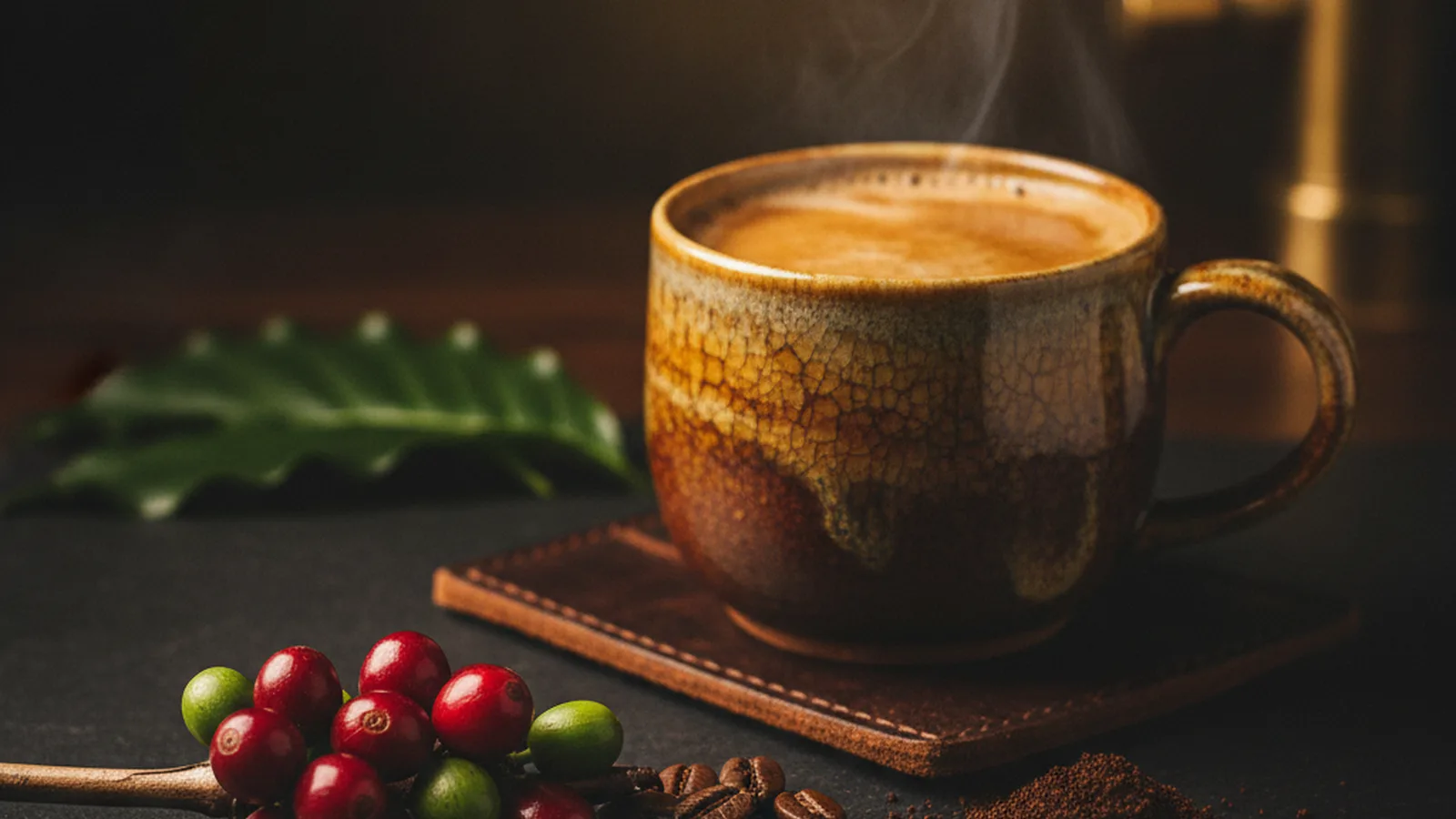
Image: Caffeine & Co studio
The Coffee Atlas
Catimor Coffee
Catimor crossed a rust-resistant Timor hybrid with Caturra to fight a 1970s leaf-rust epidemic, and inherited a flat-cup reputation the real scores complicate.
Flavor profile
avg. of 1 published reviewScale: 1-10, Coffee Review / SCA-classic-form convention. Anchored to the one real, named, dated source with a full per-attribute breakdown, because no controlled cupping of pure Catimor alone appears to exist: Coffea Guatemala's Chich'upao (Coffee Review, Oct 2024, 93 points; Aroma 9, Flavor 9, Acidity 8, Aftertaste 8, Body 9), grown from Costa Rica 90, Parainema, and Sarchimor trees, not a pure single-variety Catimor lot. The numbers above are pulled down from that ceiling to sit closer to El Quetzal Coffee Co's washed Catimor (Matagalpa, Nicaragua, 1,200+ masl), a genuine single-variety lot the roaster scores at 84 SCA points with no published per-attribute breakdown, and reflect Coffee Review's own separate characterization of ordinary Catimor as 'particularly neutral in the cup' and a blind Q-grader cupping account (Torch Coffee Labs) where a carefully fermented Guatemalan Catimor scored second-highest of six entries on sweetness and aftertaste alone, no number published. Treat this as illustrative of a well-grown, well-processed lot, not a typical commercial Catimor cup, and expect real lots to swing far wider than this small set suggests.
What it tastes like
Catimor exists because of a race against a fungus. Coffee leaf rust, Hemileia vastatrix, had already wrecked plantations across Africa and Asia by the 1950s, and researchers at Portugal’s Centro de Investigacao das Ferrugens do Cafeeiro (CIFC) in Oeiras knew the Americas were next. Their raw material was Hibrido de Timor, a natural Arabica-Robusta cross discovered growing spontaneously on the island of Timor in 1927, whose Robusta ancestry carried real rust immunity. CIFC received Timor Hybrid seed in 1958, and in 1967 crossed two rust-resistant selections (CIFC 832/1 and 832/2) with Red Caturra, itself a compact Bourbon mutation out of Brazil. The resulting lines, HW26 and H46, reached Brazil’s Instituto Agronomico in 1970, the same year leaf rust reached Brazil itself, and were named Catimor: Caturra plus Timor.
What shipped out of CIFC afterward was never one plant but a breeding template. Costa Rica’s CATIE research station received fifth-generation Catimor progeny in 1978 and produced Costa Rica 95; Honduras selected its own line into Lempira; El Salvador’s version became Catisic; Colombia ran a parallel program through Cenicafe. Honduras separately selected a different CATIE line, T5175, into IHCAFE 90. World Coffee Research’s own profiles rate these lines differently on cup potential, one rating a specific line’s high-altitude quality “Very Low,” which is the real answer to why Catimor has a reputation problem: it was never a single variety with one flavor ceiling, and some selections were bred for yield and rust resistance with cup quality as an afterthought.
That reputation runs deep. Coffee Review’s own tasting notes, in a section titled “The Cup-Suspect Varieties,” call Catimor “particularly neutral in the cup.” Yet Coffea Guatemala’s Chich’upao, grown from Costa Rica 90, Parainema, and Sarchimor trees, scored 93 points and landed at No. 14 on Coffee Review’s Top 30 Coffees of 2024. The flatness has a documented mechanism, too: Torch Coffee Labs reports that Catimor carries naturally higher chlorogenic acid, the compound behind astringency, and that fermentation breaks it down. In a blind cupping of six Q Graders, a carefully processed Guatemalan Catimor from producer Nilton Perez scored second-highest of the lineup, praised for its sweetness and syrup-like aftertaste, and still sold for less than his Bourbon simply because buyers would not pay Bourbon prices for a coffee named Catimor.
Today Catimor and its country-specific offshoots are the backbone of Vietnam’s arabica production, common across Central America, and increasingly grown in China’s Yunnan province, valued everywhere for the same reason CIFC bred it: it fruits within two years, tolerates dense planting, and shrugs off the rust that can wipe out a Typica or Bourbon field in a season. That trade-off, yield and disease resistance now, cup quality only with real effort, is the whole story behind the name.
How to brew it
Method fit for this origin · editorial guidance from roaster convention
Catimor's fuller, Robusta-influenced body and natural sweetness are exactly why blenders lean on it; El Quetzal's own roasting notes recommend a later first crack and longer development for it specifically.
Full immersion suits the heavier body, though on an under-fermented or low-altitude lot it can also amplify the astringency Catimor is known for.
Filtered clarity rewards a carefully processed, high-altitude lot, the kind that scored second-highest in a blind Q-grader cupping, but does an ordinary commercial lot few favors, since it has little top-note complexity to showcase.
⚠ Fit tiers are editorial guidance drawn from roaster convention; no industry standard scores brew fit, so we show tiers, never invented numbers. Reflects brew and roasting guidance commonly published by roasters and green buyers handling Catimor lots, not an SCA-defined standard.
Caffeine content
Caffeine by dry weight · each gold dot = 0.1%
Caffeine content generally tracks species, not origin or altitude: roughly 1.2% for Arabica versus roughly 2.2% for Robusta, close to double (see Sources & data). Catimor complicates that picture on purpose: it descends from Hibrido de Timor, a natural Arabica-Robusta cross, so it carries some Robusta ancestry even though breeders and the trade classify and sell it as Arabica. No credible per-variety caffeine measurement exists for Catimor specifically, so this entry cannot place it precisely between the two species figures above; it most likely sits closer to the Arabica end, since Timor Hybrid's Robusta contribution is a small, diluted fraction of the overall cross, but that is a reasoned inference from the breeding history, not a cited measurement.
Where to buy it
Transparency: some links on this site are affiliate links; if you buy through them we may earn a commission at no cost to you. Roasters are picked for genuine, current sourcing of this coffee, never for who pays us.
Grower-roaster selling a naturally processed Honduras Catimor direct from its own farm, alongside its Caturra for a side-by-side comparison.
View lot→Fourth-generation Nicaraguan farm whose Matagalpa Catimor is the single-variety, 84-point lot this entry's flavor data partly draws on.
View lot→Czech roaster sourcing Catimor direct from the Koho ethnic-minority growing community under Mount Langbiang, Vietnam.
View lot→Catimor is usually sold under an origin name rather than the variety itself; check the listing description or roaster's own site to confirm before buying.
View lot→Sources & data
- Ozone Coffee UK: Catimor Coffee Varietal: The Controversial Superhero1967 CIFC cross of Timor Hybrid (CIFC 832/1, 832/2) with Red Caturra (CIFC 19/1); resulting lines HW26 and H46; countries growing Catimor today; Peruvian Catimor lots scoring 82.50-87.38 points under careful processing
- Acquired Coffee: The Catimor Coffee Cultivar1927 spontaneous discovery of Timor Hybrid on Timor; CIFC received seeds in 1958 and began the breeding program in 1959; Brazil's IAC received and named the first Catimor hybrids in 1970; CATIE Costa Rica received fifth-generation progeny in 1978, source of Costa Rica 95, Lempira, and Catisic; Vietnam and Indonesia adoption to fight the 1970s-1990s leaf-rust epidemic
- World Coffee Research: Catimor 129 variety profileColombia-developed Catimor line via Cenicafe; 1970s introduction to Kenya, 1990s to Malawi, official 2006 release; altitude guidance (above 1,600 m near the equator, above 1,300 m at 5-15 degrees latitude, above 1,000 m beyond 15 degrees); intermediate rust resistance, coffee berry disease resistance, nematode susceptibility
- World Coffee Research: T5175 variety profileCosta Rica/CATIE Turrialba selection from the same H26 Portuguese cross; parent of Honduras's IHCAFE 90 and Lempira; 400-1,600 m altitude range; World Coffee Research's own quality-at-high-altitude rating of 'Very Low' for this specific line, illustrating that Catimor-family quality varies by selection, not just by processing
- Coffee Review: Traditional Coffees of Central America, tasting reportDirect quote: Catimor described as 'an early-version robusta-incorporating hybrid that is particularly neutral in the cup'
- Coffee Review: Chich'upao Guatemala, Coffea Guatemala93 points (Aroma 9, Flavor 9, Acidity 8, Aftertaste 8, Body 9), October 2024, No. 14 on Coffee Review's Top 30 Coffees of 2024; grown from Costa Rica 90, Parainema, and Sarchimor trees (1 of 2 real scored lots behind this entry's flavor profile)
- El Quetzal Coffee Co: Catimor green coffee, washedSingle-variety washed Catimor, Matagalpa, Nicaragua, 1,200+ masl, scored 84 SCA points by the producer with notes of apple, blueberry, vanilla, yellow plum, hazelnut, walnut, dulce de leche, and chocolate (2 of 2 real scored lots behind this entry's flavor profile; source for this entry's flavorTags)
- Torch Coffee Labs: The Catimor ChallengeDr. Manuel Diaz's explanation that Catimor's naturally higher chlorogenic acid content, broken down by fermentation, drives its reputation for astringency; a blind cupping of six Q Graders in which Nilton Perez's carefully processed Guatemalan Catimor scored second-highest, praised for its sweetness and syrup-like aftertaste, despite selling for less than his Bourbon lot due to the variety's name alone
- Coffee Review: scoring methodology1-10 attribute scale definition
- Crozier et al.: Espresso coffees, caffeine and chlorogenic acid intake (Food & Function, 2012)Peer-reviewed (Univ. of Glasgow): states robusta coffee beans contain almost twice as much caffeine as arabica, by species (no percentage figures given in this paper)
- Development of a fast and simple method to identify pure Arabica coffee and blended coffee by Infrared Spectroscopy (J. Food Sci. Technol., 2021, PMC8292507)Peer-reviewed, open-access: "Arabica beans usually presents 1.0 to 1.5% w.w-1 of caffeine and Robusta beans presents 2.0 to 2.5% w.w-1" (quoted verbatim, source's own wording), source for this entry's 1.2% Arabica / 2.2% Robusta figures, both within the stated ranges