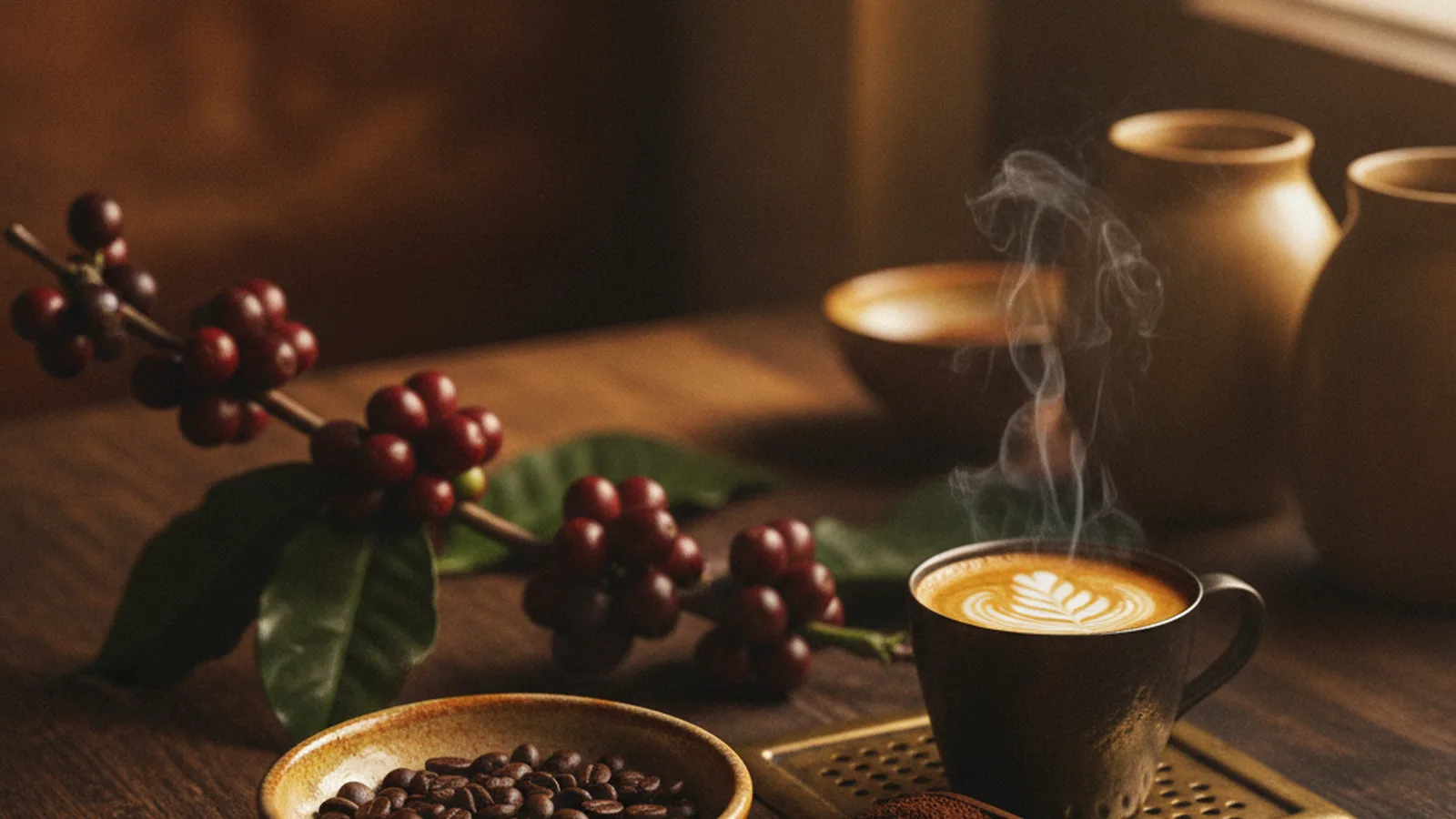
Image: Caffeine & Co studio
The Coffee Atlas
Parainema Coffee
Parainema is Honduras's 2004 Sarchimor hybrid bred for coffee leaf rust resistance, with real Coffee Review scores and sourced Cup of Excellence data.
Flavor profile
avg. of 3 published reviewsScale: 1-10, Coffee Review / SCA-classic-form convention. Averaged from 3 independently published, dated Coffee Review scores of single-variety Honduran Parainema lots (2019-2022): Cafe Grumpy's Las Flores lot, RamsHead Coffee Roasters' Finca Las Moras yellow honey lot, and Small Eyes Cafe's Paraiso El Aguacate washed lot. Not a category-wide statistical sample: published Parainema cupping scores from Honduras range from the mid-80s for ordinary commercial lots up to the mid-90s for competition-grade microlots like these three, and this high-volume, disease-resistant hybrid is grown far more often for yield and farm survival than for cup quality.
What it tastes like
Parainema is Honduras’s answer to a crisis. The 2012 coffee leaf rust epidemic that tore through Central America caused over $1 billion in damage in two years and hit an estimated 30,000 Honduran plots, and Parainema, already released in 2004 by the Instituto Hondureno del Cafe (IHCAFE) as a pedigree selection of the regional Sarchimor population T5296, became one of three varieties, alongside Lempira and IHCAFE 90, that Honduran farmers leaned on to replant at scale afterward.
The resistance traces back two generations. T5296 is the Sarchimor cross Portuguese breeders at CIFC first made in 1967: Villa Sarchi, a compact Bourbon mutation, crossed with Hibrido de Timor CIFC 832/2, a natural Arabica-Robusta hybrid that appeared spontaneously on the island of Timor in the 1920s. That Robusta ancestry is where the rust resistance comes from; IHCAFE’s further selection work in Honduras is what produced Parainema specifically, distinct from sibling national selections like El Salvador’s Cuscatleco out of the same T5296 population. A 2025 World Coffee Research multi-environment trial still ranks Parainema among the strongest all-around performers, describing it as offering “a promising balance of high resistance to coffee leaf rust and stable performance across environments.”
That resistance was the whole point, and for most of its life Parainema has been planted for survival and yield rather than flavor, World Coffee Research rates its yield potential very high and its bean size large, the profile of a workhorse variety. But grown with care, it competes: Honduras’s Cup of Excellence now runs a dedicated “Parainema Catracha” category, and its 2026 edition scored ten lots between 87.5 and 89.14, all entirely Parainema. The three independently reviewed lots behind this entry’s profile land in that same upper register: Cafe Grumpy’s Las Flores lot scored 94 on blackberry, dark chocolate, and ginger blossom; RamsHead’s yellow-honey Finca Las Moras scored 93 on red apple, almond butter, and lily; and Small Eyes Cafe’s Paraiso El Aguacate scored 93 on toffee, Bing cherry, and candied violet. A dense, syrupy body shows up across all three, the trait that makes Parainema read closer to a fruit-forward natural-process origin coffee than a thin, purely disease-resistant workhorse.
How to brew it
Method fit for this origin · editorial guidance from roaster convention
Filtered brewing lets the fruit-forward acidity and floral top notes that the best-scoring Parainema lots are reviewed for come through clean.
The dense, syrupy body holds up under pressure, but dial-in matters more than usual since cup quality swings widely across this hybrid's many growing regions.
Full immersion suits the heavier body, but can flatten the bright citrus and floral notes that separate a competition-grade lot from an ordinary commercial one.
⚠ Fit tiers are editorial guidance drawn from roaster convention; no industry standard scores brew fit, so we show tiers, never invented numbers. Reflects brew guidance commonly published by specialty roasters for dense-bodied Sarchimor-family lots like Parainema, not an SCA-defined standard.
Caffeine content
Caffeine by dry weight · each gold dot = 0.1%
Caffeine content tracks species, not variety, origin, altitude, or processing: roughly 1.2% for Arabica versus roughly 2.2% for Robusta, close to double (see Sources & data). Parainema is bred and traded as Arabica despite carrying rust-resistance genes introgressed from Robusta through its Timor Hybrid grandparent; no credible per-variety caffeine figure exists at a category level, so the comparison above is by species only, not a measurement of this specific hybrid.
Where to buy it
Transparency: some links on this site are affiliate links; if you buy through them we may earn a commission at no cost to you. Roasters are picked for genuine, current sourcing of this coffee, never for who pays us.
Honduras-based roaster specializing in Parainema, roasting it at origin rather than after export.
View lot→Bozeman, Montana roaster whose Finca Las Moras Parainema yellow honey lot scored 93 points from Coffee Review in October 2021.
View lot→NYC micro-roaster with a recurring Honduras Parainema program and transparent, lot-specific sourcing.
View lot→Erie, Pennsylvania specialty roaster listing a natural-process Nicaragua Parainema among its single-origin lots.
View lot→Parainema surfaces under several origin names (Honduras, Nicaragua, El Salvador); search by variety name and check the roast date and farm naming before buying.
View lot→Sources & data
- World Coffee Research: Parainema variety profilePedigree selection of T5296 by Instituto Hondureno del Cafe (IHCAFE), released 2004; high leaf rust resistance, partial nematode resistance, coffee berry disease tolerance; very high yield, large bean size; altitude bands by latitude
- World Coffee Research: T5296 (Sarchimor) variety profileTimor Hybrid CIFC 832/2 x Villa Sarchi cross made by CIFC (Portugal) in 1967, field trials from 1971 across Central America and beyond; T5296 is the shared population behind Parainema, Cuscatleco, and other national selections
- World Coffee Research: Coffee leaf rust knows no borders, neither does coffee science (2025)Multi-environment variety trial naming Parainema, alongside Kartila 1 and IPR107, as offering "a promising balance of high resistance to coffee leaf rust and stable performance across environments"
- Perfect Daily Grind: How Is Honduras Responding to Recent Coffee Leaf Rust Outbreak?2012 Central American rust epidemic caused over US $1 billion in damage in two years (citing USAID) and hit roughly 30,000 Honduran plots; Parainema was one of three main varieties, with Lempira and IHCAFE 90, that Honduran farmers replanted at scale afterward
- Alliance for Coffee Excellence: Honduras Cup of Excellence 2026 resultsDedicated "Parainema Catracha" competition category; 10 winning lots scored 87.5 to 89.14, all grown entirely to the Parainema variety
- Coffee Review: Honduras Las Flores Parainema, Cafe GrumpyCupping scores (1 of 3 averaged)
- Coffee Review: Honduras Finca Las Moras Parainema Yellow Honey, RamsHead Coffee RoastersCupping scores (2 of 3 averaged)
- Coffee Review: Honduras Paraiso El Aguacate Parainema, Small Eyes CafeCupping scores (3 of 3 averaged)
- Coffee Review: scoring methodology1-10 attribute scale definition
- Crozier et al.: Espresso coffees, caffeine and chlorogenic acid intake (Food & Function, 2012)Peer-reviewed (Univ. of Glasgow): states robusta coffee beans contain almost twice as much caffeine as arabica, by species (no percentage figures given in this paper)
- Development of a fast and simple method to identify pure Arabica coffee and blended coffee by Infrared Spectroscopy (J. Food Sci. Technol., 2021, PMC8292507)Peer-reviewed, open-access: "Arabica beans usually presents 1.0 to 1.5% w.w-1 of caffeine and Robusta beans presents 2.0 to 2.5% w.w-1" (quoted verbatim, source's own wording), source for this entry's 1.2% Arabica / 2.2% Robusta figures, both within the stated ranges