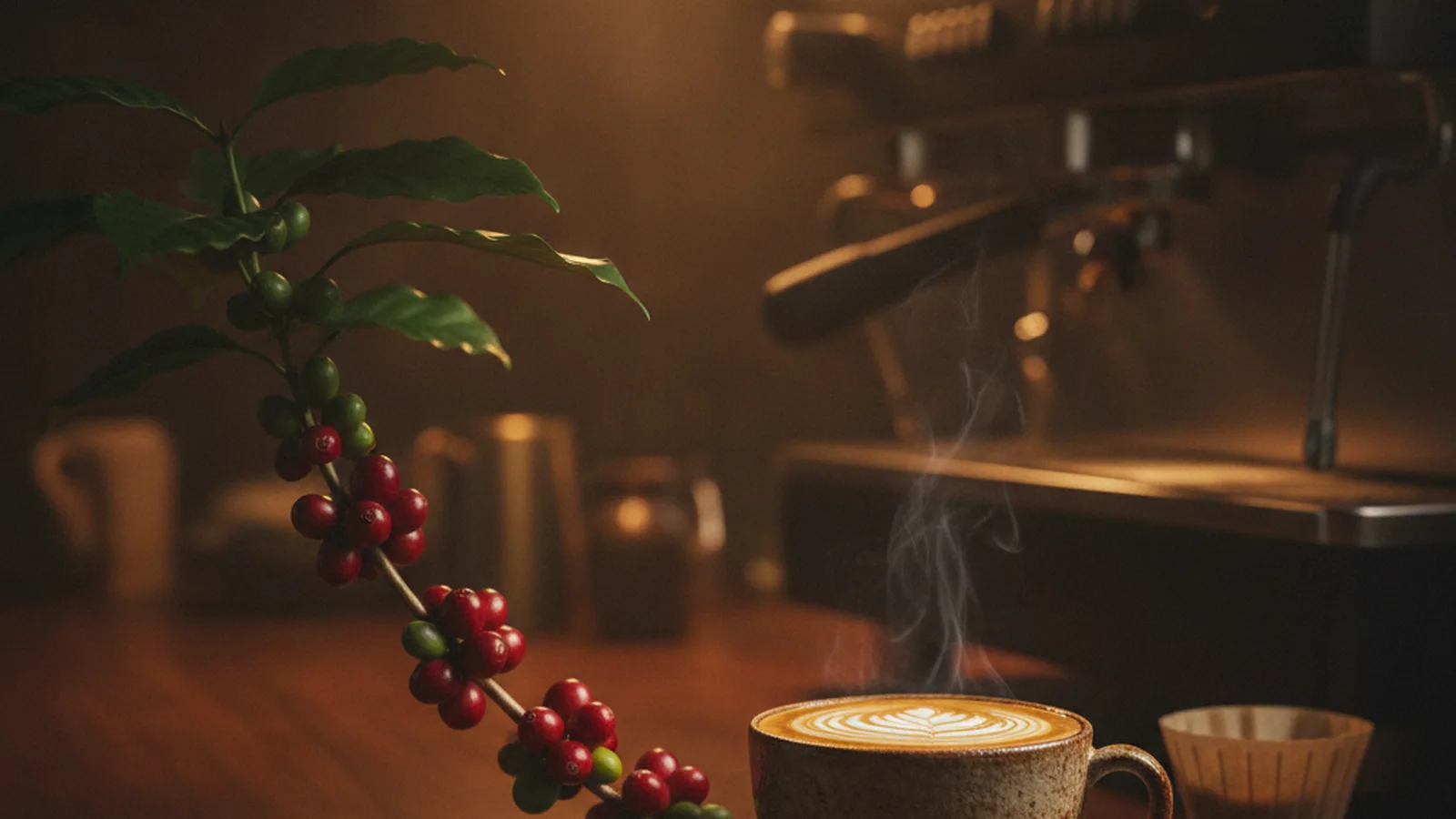
Image: Caffeine & Co studio
The Coffee Atlas
Eugenioides Coffee
Eugenioides is Arabica's own wild parent species, grown as a genuine rarity in Colombia and Ecuador, with a sourced flavor profile and real citations.
Flavor profile
avg. of 1 published reviewScale: 1-10, Coffee Review / SCA-classic-form convention. This profile is one published Coffee Review score, not an average across lots: Ecuador Eugenioides Natural, Finca Perla Negra, roasted by Paradise Roasters (reviewed January 2020, overall 94; Aroma 9, Acidity/Structure 8, Body 9, Flavor 9, Aftertaste 9). It is the only eugenioides lot with a full Coffee Review per-attribute breakdown that I could find; other named lots, including Onyx Coffee Lab's and Gardelli Coffee's Colombia Inmaculada Eugenioides, carry roaster- or retailer-published overall scores but not that per-attribute breakdown, so they are not folded into this figure. Eugenioides yields only a few hundred grams of cherry per tree, so every lot, including this one, is a tiny, unique harvest rather than a representative crop average.
What it tastes like
Coffea eugenioides is not a varietal of Arabica, it is one of Arabica’s two wild parents. A 2024 genome study in Nature Genetics dates the natural hybridization of eugenioides and Coffea canephora that produced Coffea arabica to somewhere between 350,000 and 610,000 years ago, and traces Arabica’s chloroplast genome, which plants inherit maternally, directly back to eugenioides. The species grows wild in the highland forests of the eastern Democratic Republic of Congo, Rwanda, Uganda, Kenya, and western Tanzania, where it was never cultivated or consumed on its own: a small, delicate understory tree with sparse, tiny cherries that gave growers little reason to bother with it once Arabica itself existed.
That changed only in the past decade, once the Holguin family’s Finca Inmaculada, in the Pichinde hills outside Cali, Colombia, began propagating pure eugenioides as a specialty crop in its own right, alongside a second, separately documented planting at Finca Perla Negra in Pichincha, Ecuador. Yields are tiny, reportedly a few hundred grams of cherry per tree, which keeps pure eugenioides among the rarest coffees any roaster can offer. Paradise Roasters’ Ecuador Eugenioides Natural scored 94 points from Coffee Review in January 2020, described in the blind assessment as “round, sweet, complex, original,” with magnolia, musk, and lemon verbena in the aroma and a cup carrying maple syrup, peach, and jackfruit through a buoyant, satiny finish. Other roasters working directly with Finca Inmaculada report a similar register: papaya, guava, strawberry yogurt, and a “cereal milk” sweetness, with almost no bitterness in the cup.
The sweetness is not an accident of processing. Eugenioides carries one of the lowest caffeine contents ever measured in the genus Coffea, averaging roughly 0.5% by dry weight in peer-reviewed sampling of wild Kenyan accessions, under half of Arabica’s own roughly 1.2% and a fifth of Robusta’s roughly 2.2%. Caffeine and coffee’s bitter chlorogenic acids track together across wild Coffea species, so a plant this low in one tends to run low in the other too, which is the leading explanation for why eugenioides tastes so sweet with so little bite. That profile won over competition judges fast: at the 2021 World Barista Championship, Diego Campos took first place and Andrea Allen placed second, both building their routines around eugenioides, a jump from obscure botanical curiosity to competition-circuit fixture in a single season.
Roasters tend to treat eugenioides more like a delicate single-origin filter coffee than a blending component: light roasts to protect its natural sugars, and pour-over or similarly gentle brewing to let the floral and fruit notes carry without concentrated, roast-driven bitterness crowding them out. Whether it ever becomes more than a once-a-year novelty lot depends entirely on whether Finca Inmaculada, Finca Perla Negra, or another grower can meaningfully improve on cherry counts this small.
How to brew it
Method fit for this origin · editorial guidance from roaster convention
Filtered clarity lets the coffee's rare, almost tea-like sweetness and delicate fruit come through with nothing competing for attention, how most reviewers and 2021 World Barista Championship competitors served it.
The silky, syrupy body described across reviews holds up to full immersion, but the muted acidity means French press loses some of the top-note clarity pour-over preserves.
Competitors and roasters consistently treat eugenioides as a filter coffee: concentrating it risks pulling roast-driven bitterness forward in a cup whose entire signature is sweetness with almost none.
⚠ Fit tiers are editorial guidance drawn from roaster convention; no industry standard scores brew fit, so we show tiers, never invented numbers. Reflects how competition baristas (2021 World Barista Championship) and the roasters who sell eugenioides have actually served it, light-roasted and filtered, rarely as espresso, not an SCA-defined standard. See Sources & data.
Altitude & region
Growing elevation, meters above sea level · this entry vs comparison bands
Finca Inmaculada's 1,750-2,000 m figure is this entry's own directly sourced commercial growing range, from the farm's own site. Coffea eugenioides' wild native range, 1,500-2,200 m across its East African highland home in DR Congo, Rwanda, Uganda, Kenya, and Tanzania, is shown for species-level context per PROTA's botanical survey, not a cultivated-lot measurement. Ethiopia Yirgacheffe and Colombia Huila are shown for scale using typical ranges already published elsewhere on this site, not lot-specific measurements.
Caffeine content
Caffeine by dry weight · each gold dot = 0.1%
The two bars above are this site's standard species reference points: roughly 1.2% caffeine by dry weight for Arabica and roughly 2.2% for Robusta (see Sources & data). Eugenioides is neither: it is one of the two wild species behind that first bar's own genome, and its own green-bean caffeine content runs far below both figures shown, roughly 0.5% by dry weight (0.44 to 0.60% across four wild Kenyan accessions analyzed by Campa et al., 2005), under half the first bar and about a fifth of the second. That unusually low caffeine is also the leading explanation in the literature for eugenioides' high sweetness and near-absence of bitterness in the cup: caffeine and coffee's bitter chlorogenic acids rise and fall together across wild Coffea species, and eugenioides sits near the bottom of both scales. This is a wild-species baseline from botanical sampling, not a measurement of any single commercial lot.
Where to buy it
Transparency: some links on this site are affiliate links; if you buy through them we may earn a commission at no cost to you. Roasters are picked for genuine, current sourcing of this coffee, never for who pays us.
Arkansas competition-circuit roaster that has repeatedly sourced Finca Inmaculada's eugenioides harvests, including a 2023 Echelon-series lot.
View lot→Minneapolis roaster behind the Coffee Review-scored Ecuador Eugenioides Natural this entry's flavor profile is built on; rotates rare-species lots through its Pinnacle and Rare Coffees programs.
View lot→Barcelona roaster sourcing directly from the Holguin family's Finca Inmaculada, the Colombian farm most credited with first commercializing eugenioides at any real scale.
View lot→Pure eugenioides almost never reaches general marketplaces; selection is thin and inconsistent, so confirm a listing actually names the species (not just 'rare coffee') and check the roast date before buying.
View lot→Sources & data
- Coffee Review: Ecuador Eugenioides Natural, Finca Perla Negra (Paradise Roasters)Full attribute cupping scores and tasting notes used for this entry's flavor profile; reviewed January 2020, overall score 94, origin Pichincha, Ecuador
- Coffee Review: scoring methodology1-10 attribute scale definition
- Inmaculada Coffee Farms: Our CoffeesFinca Inmaculada's own altitude figure (1,750-2,000 masl, Pichinde, Valle del Cauca), species classification, and processing methods
- Nomad Coffee: Eugenioides product pageCorroborating altitude (1,900-2,000 masl), farm attribution to the Holguin family, natural processing, and tasting notes
- Campa, Doulbeau, Dussert, Hamon, Noirot: Qualitative relationship between caffeine and chlorogenic acid contents among wild Coffea species (Food Chemistry, 2005)Peer-reviewed: Coffea eugenioides (Kenya accessions) measured at 0.51% mean caffeine content, range 0.44-0.60% dry matter basis, versus 0.00-2.64% across the other 20 wild species and taxa sampled
- PROTA (Plant Resources of Tropical Africa) via Pl@ntUse: Coffea eugenioidesNative range (eastern DR Congo, Rwanda, Uganda, Kenya, western Tanzania), wild altitude range 1,500-2,200 m, caffeine content 0.3-0.6 g per 100 g dry matter, and its role as a parent species of Coffea arabica
- Salojarvi et al.: The genome and population genomics of allopolyploid Coffea arabica reveal the diversification history of modern coffee cultivars (Nature Genetics, 2024)Peer-reviewed: dates the natural hybridization of Coffea canephora and Coffea eugenioides that produced Coffea arabica to 350,000-610,000 years ago, and finds Arabica's chloroplast genome derives from eugenioides
- Sprudge: What Is Eugenioides Coffee?History as a once-'abandoned' species, Finca Inmaculada's role in commercializing it, and its divisive reception among drinkers
- Barista Magazine: Eugenioides Coffee Soars to Competition Success2021 World Barista Championship: Diego Campos' winning routine and Andrea Allen's second-place routine both used eugenioides; farm attribution to the Holguin family at Finca Inmaculada
- MTPak Coffee: Eugenioides coffee, a roaster's guide to this unique speciesRoasting guidance (light roasts favored to preserve natural sweetness) and tasting descriptors (sesame snaps, toasted marshmallow, lemon drops)
- Development of a fast and simple method to identify pure Arabica coffee and blended coffee by Infrared Spectroscopy (J. Food Sci. Technol., 2021, PMC8292507)Peer-reviewed, open-access: source for this entry's 1.2% Arabica / 2.2% Robusta reference-bar figures
- Crozier et al.: Espresso coffees, caffeine and chlorogenic acid intake (Food & Function, 2012)Peer-reviewed (Univ. of Glasgow): corroborates robusta coffee beans containing almost twice as much caffeine as arabica, by species