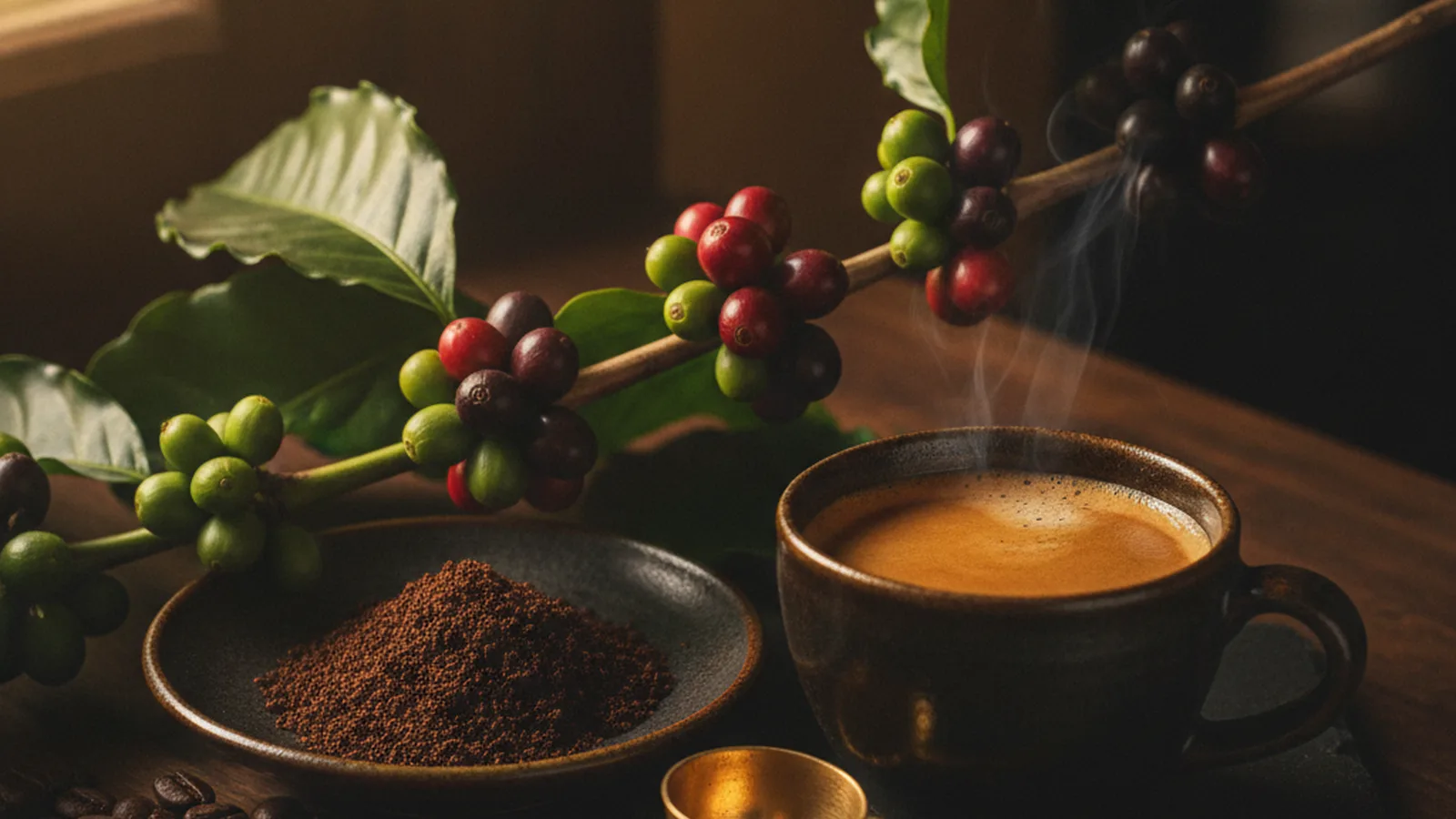
Image: Caffeine & Co studio
The Coffee Atlas
Castillo Coffee Variety
Castillo is Cenicafe's 2005 rust-resistant Caturra x Timor Hybrid release covering most of Colombia: the breeding story and the real Caturra quality debate.
Flavor profile
avg. of 2 published reviewsScale: 1-10, Coffee Review / SCA-classic-form convention. Averaged from 2 independently published, dated Coffee Review scores of Colombian lots explicitly identified as 100% Castillo variety: Cauca Castillo YN-05 (Jaunt Coffee Roasters, double-anaerobic fermented) and El Silencio Castillo Natural (SOT Coffee Roaster, natural-processed). Both are specialty-showcase lots put through unusual fermentation or drying, not plain-washed baseline Castillo, so they sit well above the 83-85 point range more typical commercial Castillo lots score. A 2014-2015 blind trial found no significant average score gap between Castillo and Caturra grown and processed identically (see body), so read this profile as evidence of Castillo's real high-quality ceiling, not its everyday cup.
What it tastes like
Castillo exists because of a fungus and a farsighted research programme. In 1968, Cenicafe, Colombia’s coffee research centre, began crossing Caturra, a compact Bourbon mutation prized for its cup quality, with Hibrido de Timor, a naturally occurring Arabica-Robusta cross whose Robusta ancestry carries real leaf-rust immunity. That work first produced the compound “Colombia” variety in 1982, and under researchers Jaime Castillo Zapata and German Moreno, continued for over two more decades of backcrossing and selection, released in 2005 as Castillo: a five-generation backcross bred to keep as much Caturra cup quality as possible while holding onto Timor Hybrid’s rust resistance. The timing mattered enormously. A severe leaf-rust epidemic hit Colombia starting around 2008, and because Cenicafe already had a resistant variety ready to distribute, growers had somewhere to turn instead of losing their farms outright.
Castillo was never released as one plant. Cenicafe split it into seven regional component blends, Naranjal, Paraguaicito, Santa Barbara, Pueblo Bello, El Rosario, La Trinidad, and El Tambo, each selected for a specific agroclimatic zone’s own climate and soil, a genetic-diversity hedge against the rust fungus evolving past a single resistance gene. The strategy is still paying off: World Coffee Research reports that the rust-resistant share of Colombia’s coffee area climbed from 35 percent in 2010 to 87 percent today, with a further-improved Castillo 2.0 released in 2024 to keep ahead of the disease.
Castillo also inherited a reputation problem: early releases, and the variety’s association with high-volume commercial farming in Colombia’s Eje Cafetero, left many cuppers assuming it could never match Caturra in the cup. A 2014-2015 blind trial by Catholic Relief Services’ Borderlands project complicates that assumption directly: paired Castillo and Caturra samples from 22 farms in Narino, cupped blind in Chicago, showed no statistically significant average score gap between the two varieties when grown and processed the same way. The two independently reviewed Castillo lots behind this entry’s flavor profile back that up: Jaunt’s double-anaerobic Cauca Castillo YN-05 scored 93 on red plum and freesia, while SOT’s natural-processed El Silencio scored 92 on dried plum and baking chocolate. Neither is a typical commercial lot, but both show what the variety a lot of the trade still writes off as merely “productive” can do in careful hands.
How to brew it
Method fit for this origin · editorial guidance from roaster convention
Castillo's fuller body and balanced, chocolate-and-caramel sweetness are exactly why it anchors so many Colombian commercial and espresso blends.
Well-grown, carefully processed lots reward filtered clarity, but Castillo's moderate acidity gives it less dramatic top-note lift than a higher-acid origin.
Full immersion suits the heavier body roasters describe, though it can mute the stone-fruit notes that distinguish the best Castillo lots from ordinary ones.
⚠ Fit tiers are editorial guidance drawn from roaster convention; no industry standard scores brew fit, so we show tiers, never invented numbers. Reflects brew guidance commonly published by specialty roasters and green buyers handling Castillo lots, not an SCA-defined standard.
Caffeine content
Caffeine by dry weight · each gold dot = 0.1%
Caffeine content tracks species, not variety, origin, altitude, or processing: roughly 1.2% for Arabica versus roughly 2.2% for Robusta, close to double (see Sources & data). Castillo descends from Hibrido de Timor, a natural Arabica-Robusta cross, but five generations of backcrossing to Caturra dilute that ancestry sharply, and breeders and the trade classify and sell it as Arabica. No credible per-variety caffeine measurement exists for Castillo specifically, so this entry cannot place it precisely; it almost certainly sits close to the Arabica figure above given how diluted the Robusta contribution is, but that is a reasoned inference from the breeding history, not a cited measurement.
Where to buy it
Transparency: some links on this site are affiliate links; if you buy through them we may earn a commission at no cost to you. Roasters are picked for genuine, current sourcing of this coffee, never for who pays us.
San Diego roaster whose double-anaerobic Cauca Castillo YN-05, from Finca El Paraiso, scored 93 points from Coffee Review in May 2024.
View lot→Kansas roaster carrying a washed Antioquia Castillo from Carmen Montoya's three-hectare farm, a Cup of Excellence competitor.
View lot→Roaster sourcing a washed Tabi-and-Castillo lot from Finca El Ocaso in Salento, Quindio, with published caramel and red-fruit tasting notes.
View lot→Sources & data
- Green Coffee Collective: Castillo Coffee Variety glossaryFive-generation backcrossing programme from a Caturra x Colombia (a Catimor derivative) cross; 2005 release; regional sub-varieties including Castillo El Tambo and Castillo Naranjal; cup-quality controversy between early and newer Castillo releases
- Trabocca: Castillo variety in a nutshellOver two decades of Cenicafe development; leaf-rust resistance as the primary driver of grower adoption in Colombia
- Perfect Daily Grind: Coffee Varieties, Debunking the Myths Around Castillo1968 Cenicafe programme start; 23 years to the 2005 release; Hernando Cortina quote on rust resistance holding 12+ years post-release; summary of the CIAT/World Coffee Research/Kansas State 2014-2015 sensory trial finding similar cup scores between Castillo and Caturra
- World Coffee Research: Colombia country pageRust-resistant-variety share of Colombia's coffee area rising from 35 percent in 2010 to 87 percent today; 2024 release of Castillo 2.0; WCR-Cenicafe genetic-improvement partnership
- Federacion Nacional de Cafeteros (Santander): Variedades Castillo RegionalesSeven regional Castillo component blends (Naranjal, Paraguaicito, Santa Barbara, Pueblo Bello, El Rosario, La Trinidad, El Tambo), each selected for a specific agroclimatic zone's climate and soil
- MTPak Coffee: Castillo coffee, a roaster's guide to coffee varietiesVariety named after Cenicafe researcher Jaime Castillo; smooth, bright, balanced cup description; roast-level guidance
- Routes Coffee: What Is Castillo Coffee?Independent corroboration of the Jaime Castillo Zapata namesake; department-level altitude bands (Huila 1,600-2,000 m, Narino 1,800-2,200 m); stone-fruit notes above 1,500 m; chocolate and caramel described as Castillo's consistent baseline notes generally, not tied to that altitude figure
- The Colombian Coffee Company: CastilloCaturra as male parent, Hibrido de Timor as female parent; concentration in the Eje Cafetero traditional coffee zone; historical reputation for a flatter cup versus newer natural-process microlots
- Coffee Review: Colombia Cauca Castillo YN-05, Jaunt Coffee RoastersCupping scores (1 of 2 averaged)
- Coffee Review: Colombia El Silencio Castillo Natural, SOT Coffee RoasterCupping scores (2 of 2 averaged)
- Coffee Review: scoring methodology1-10 attribute scale definition
- Daily Coffee News: Simple Question, Myriad Answers, Castillo or Caturra?Catholic Relief Services Borderlands project results: paired Castillo and Caturra samples from 22 farms in Narino, harvested and processed identically, cupped blind across two panels (October 2014 and January 2015) led by Paul Songer at Intelligentsia Roasting Works in Chicago, found no statistically significant average score difference between the two varieties
- Crozier et al.: Espresso coffees, caffeine and chlorogenic acid intake (Food & Function, 2012)Peer-reviewed (Univ. of Glasgow): states robusta coffee beans contain almost twice as much caffeine as arabica, by species (no percentage figures given in this paper)
- Development of a fast and simple method to identify pure Arabica coffee and blended coffee by Infrared Spectroscopy (J. Food Sci. Technol., 2021, PMC8292507)Peer-reviewed, open-access: "Arabica beans usually presents 1.0 to 1.5% w.w-1 of caffeine and Robusta beans presents 2.0 to 2.5% w.w-1" (quoted verbatim, source's own wording), source for this entry's 1.2% Arabica / 2.2% Robusta figures, both within the stated ranges