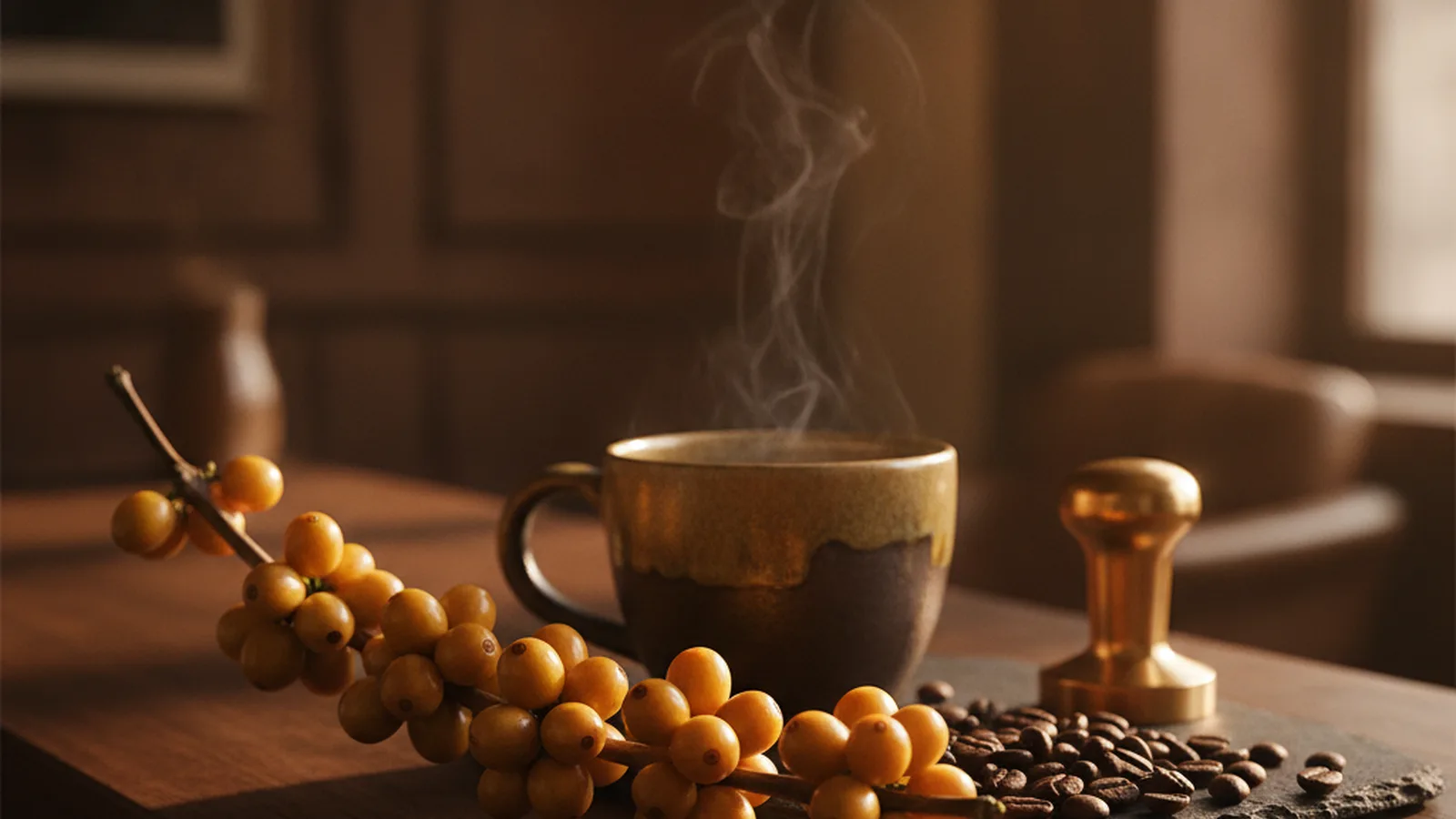
Image: Caffeine & Co studio
The Coffee Atlas
Brazil Yellow Catuai
Yellow Catuai is a Brazilian dwarf cultivar bred from a 1949 Mundo Novo and Caturra cross, scored here from three real, dated Coffee Review lots.
Flavor profile
avg. of 3 published reviewsScale: 1-10, Coffee Review / SCA-classic-form convention. Averaged from 3 independently published Coffee Review lot scores of Yellow Catuai from Minas Gerais: Ritual Coffee Roasters (Cerrado, pulped natural, March 2014, 91 points), Equator Coffees (Bela Vista, Dom Vicoso, pulped natural, March 2014, 93 points), and Min Enjoy Cafe (Veloso Estate, Cerrado Mineiro, natural, May 2022, 93 points). Not a category-wide sample: two lots are pulped natural and one is natural, two date from the same month, and roasters submit their better lots for review, so these numbers describe well-graded microlots, not the cultivar's everyday commercial cup. Per-attribute averages are rounded to one decimal.
What it tastes like
Yellow Catuai is an engineered answer to a farming problem, not a landrace. Researchers at Brazil’s Instituto Agronomico de Campinas crossed Mundo Novo with Caturra Amarelo to pair Mundo Novo’s vigor with Caturra’s compact size. The cross was made in 1949 and the result was released in 1972 as a semi-dwarf tree that can be planted densely and picked easily. The yellow cherry color is inherited from the Caturra Amarelo parent, and the same source cautions that cherry color moves the cup less than climate, altitude and processing do. The tradeoff is disease: that source lists very high susceptibility to leaf rust.
The three Coffee Review lots behind the scores are soft and sweet rather than loud. Ritual’s Cerrado pulped natural reads honeysuckle-like flowers, apple, caramel and walnut, and finishes at 91. Equator’s Bela Vista microlot from Dom Vicoso adds peach and bergamot-like citrus with milk chocolate and the highest acidity score of the three. The Veloso Estate natural leans toward cocoa nib, tea rose and dried apple with a buttery mouthfeel.
What the data cannot say is that Yellow Catuai is better than Red Catuai or any other cultivar. All three lots are processed, farmed and roasted differently, and only a handful of reviews stand behind the averages. Treat the profile as a fair picture of what good Brazilian microlots of this variety can taste like: balanced, gently bright, and sweet.
How to brew it
Method fit for this origin · editorial guidance from roaster convention
Filtered brewing keeps the delicate floral and apple top notes reviewers describe, which a heavier immersion brew would blur.
The caramel, cocoa and nut sweetness suits espresso and milk drinks, though the lighter floral notes mostly get lost.
The soft, plush body carries well in immersion, at the cost of some of the aromatic definition.
⚠ Fit tiers are editorial guidance drawn from roaster convention; no industry standard scores brew fit, so we show tiers, never invented numbers. Reflects brew guidance commonly published by specialty roasters for sweet, balanced Brazilian lots, not an SCA-defined standard.
Altitude & region
Growing elevation, meters above sea level · this entry vs comparison bands
Yellow Catuai's own band is the Cerrado Mineiro regional range from Klatch Coffee (see Sources & data), checked against three individual lots, not a cultivar-specific measurement. Guatemala Huehuetenango, Kenya AA and Ethiopia Yirgacheffe are shown for scale only, using bands already used elsewhere in this Atlas.
Caffeine content
Caffeine by dry weight · each gold dot = 0.1%
Caffeine content tracks species, not variety, origin, altitude, or processing: Robusta beans carry almost twice as much as Arabica (see Sources & data). Yellow Catuai is 100% Arabica; no credible per-variety caffeine figure exists at a category level, so the comparison is by species only, not a measurement of this specific lot.
Where to buy it
Transparency: some links on this site are affiliate links; if you buy through them we may earn a commission at no cost to you. Roasters are picked for genuine, current sourcing of this coffee, never for who pays us.
San Diego-area nano roastery that lists a natural Yellow Catuai from Fazenda do Cruzeiro, roasted to order (seasonal; check current listings).
View lot→Has listed a Yellow Catuai from Fazenda Sao Luiz in Cerrado Mineiro; that lot showed as sold out when checked, so look for the next release.
View lot→Selection is wide and inconsistent for a named cultivar; check the roast date, whether the bag actually names Yellow Catuai, and seller reviews before buying.
View lot→Sources & data
- Ozone Coffee Roasters: Catuai coffee variety1949 IAC cross of yellow Caturra and Mundo Novo, release in 1972, semi-dwarf habit, very high leaf rust susceptibility; notes that cherry colour moves the cup less than climate, altitude and processing
- Diario do Comercio: Catuai IAC, a variety that marked Brazilian coffee historyMundo Novo x Caturra Amarelo parentage at the Instituto Agronomico de Campinas; aim of combining Mundo Novo vigor with Caturra's compact size; Catuai and Mundo Novo came to dominate Brazilian plantings
- Coffee Review: Brazil Yellow Catuai, Ritual Coffee RoastersCupping scores (1 of 3 averaged); March 2014; 91 points; Fazenda Esperanca, Cerrado, pulped natural
- Coffee Review: Brazil Bela Vista, Equator CoffeesCupping scores (2 of 3 averaged); March 2014; 93 points; Yellow Catuai, Dom Vicoso, pulped natural
- Coffee Review: Brazil Natural Veloso Estate, Min Enjoy CafeCupping scores (3 of 3 averaged); May 2022; 93 points; Yellow Catuai, Fazenda Santa Cecilia, Cerrado Mineiro, natural
- Coffee Review: scoring methodology1-10 attribute scale definition
- Klatch Coffee: Brazil Klatch Diamond ReserveRegional altitude bands: Cerrado Mineiro 800-1,300 m, Matas de Minas 600-1,450 m; mentions Yellow Catuai grown by farms in the program
- The Way to Coffee: Brazil Sao SilvestreCerrado Mineiro lot at 1,250 m listing Yellow Catuai among several varieties
- Origen Coffee Roasters: Brazil Fazenda Cruzeiro Natural Yellow CatuaiYellow Catuai lot at 905-1,160 m, natural process, currently purchasable
- Tico Coffee Roasters: Brazil Fazenda Sao LuizYellow Catuai lot at 900-1,200 m, Cerrado Mineiro, natural anaerobic; sold out when checked
- Crozier et al.: Espresso coffees, caffeine and chlorogenic acid intake (Food & Function, 2012)Peer-reviewed (Univ. of Glasgow): states robusta coffee beans contain almost twice as much caffeine as arabica, by species (no percentage figures given in this paper)